Pro Program Live Chat +8619050185756

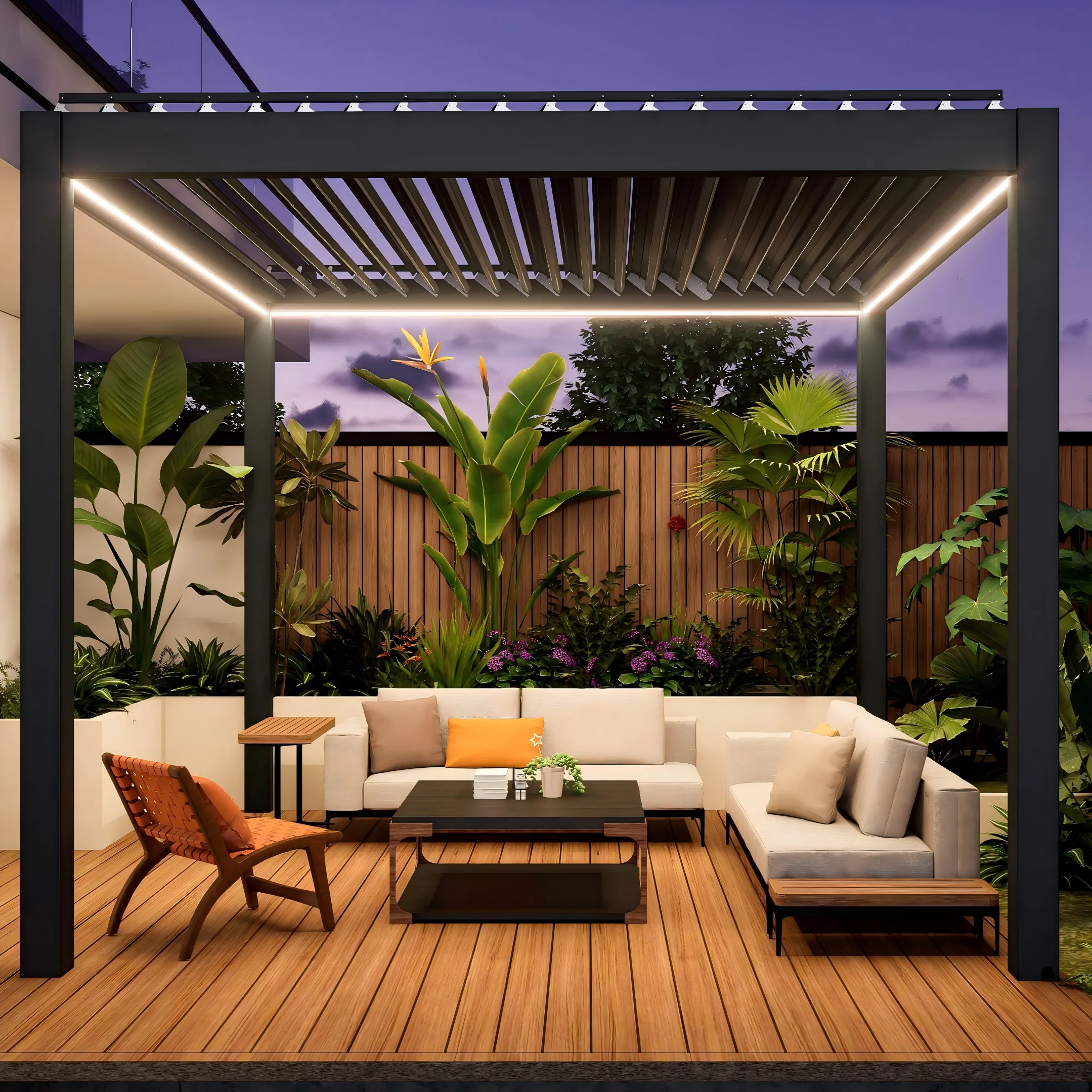
The best pergola lighting plan uses several low-level light sources instead of one bright fixture. Start with glare-free ambient light for conversation, add task lighting where people cook, serve, or read, and use accent lighting sparingly. Choose fixtures and electrical components specifically suitable for the installation location, keep light directed where it is useful, and have a qualified local electrician design and install the wiring.
Start With the Activities Under Your Pergola
Lighting should follow the way the pergola will be used. A lounge needs soft, even illumination that lets people see faces without feeling as though they are under a spotlight. A dining table benefits from more focused light over the tabletop. A path, step, grill, or serving counter needs clear visibility for movement and tasks.
Before selecting fixtures, draw the pergola footprint and mark furniture, doors, steps, cooking equipment, outlets, switches, and the main walking routes. Then label each area as ambient, task, accent, or circulation lighting. This simple exercise prevents a common problem: buying attractive fixtures first and discovering later that they create shadows, glare, or dark walking zones.
Use Three Lighting Layers
Ambient Lighting for the Overall Space
Ambient light provides the general illumination that makes the pergola feel comfortable after sunset. Integrated linear lights along beams can distribute light more evenly than a single central fixture. Shielded downlights, wall-mounted fixtures on an adjacent house, or indirect light reflected from an appropriate surface can also contribute.
Keep ambient lighting gentle and dimmable when the selected system supports it. The goal is not to reproduce daytime brightness. Multiple modest sources typically create a more relaxed setting and make it easier to adjust the mood for dinner, conversation, or cleanup.
Task Lighting Where Work Happens
Task lighting belongs at a grill, beverage station, sink, dining table, reading chair, or other activity zone. Position it so the user’s body does not cast a shadow across the work surface. For a cooking area, light should help the user see controls, food, and the surrounding counter without producing distracting reflections.
Lighting near cooking equipment must respect the appliance manufacturer’s required clearances and the pergola’s model-specific documentation. Heat, grease, gas, electricity, and overhead structures require coordinated planning. A qualified local professional should confirm fixture location, wiring method, ventilation, and applicable permits or inspections.
Accent Lighting for Depth and Character
Accent light can reveal a planter, textured wall, architectural beam, or specimen tree and make the view beyond the pergola feel intentional. Use it selectively. Too many accent fixtures create visual clutter and can compete with the people and activities inside the space.
Aim accent lighting away from neighboring windows and avoid sending unnecessary light into the sky. DarkSky International and the Illuminating Engineering Society describe responsible outdoor lighting as useful, targeted, low level, controlled, and warm-colored. Those principles provide a practical framework for a residential pergola, even when a project is not seeking any particular certification. See the Five Principles for Responsible Outdoor Lighting for the source guidance.
Control Glare Before Adding Brightness
Glare occurs when a bright source is directly visible or contrasts sharply with a dark background. It can make a space feel less comfortable even when the measured light level is adequate. Under a pergola, eye-level views matter because guests are seated and often look across the space or upward toward the roof.
- Use shielding, diffusers, or recessed placement so bare light sources are not prominent.
- Aim light down toward tables, counters, steps, and paths rather than outward.
- Check views from every seat, not only while standing.
- Use matte or low-reflectance finishes near bright linear lighting where practical.
- Add a dimmer or separate lighting zones when compatible with the chosen equipment.
More lumens are not automatically better. Begin with useful placement and control, then increase output only if the actual tasks require it. A sample fixture or temporary mockup at night can reveal issues that a daytime plan will miss.
Choose a Comfortable Light Appearance
Warm-colored light generally feels inviting around wood, stone, plants, and outdoor furniture. Cooler light may appear crisp but can feel visually harsh in a relaxed lounge when it is too intense. The best choice should also coordinate with light coming from the house so the patio does not look divided into conflicting colors.
Color temperature is only one part of appearance. Diffusion, fixture spacing, brightness, surface colors, and dimming behavior all influence the result. If integrated lighting is included with a pergola model, confirm its documented color appearance, control method, replacement pathway, and compatibility before designing the rest of the landscape lighting around it.
Compare Common Pergola Lighting Approaches
| Approach | Best use | Planning consideration |
|---|---|---|
| Integrated linear lighting | Even ambient light and a clean architectural look | Confirm model compatibility, controls, service access, and wet-location suitability in documentation |
| Shielded downlights | Tables, counters, and circulation zones | Coordinate spacing with beams and avoid glare from seated positions |
| Pendant lighting | A visual focal point over dining or lounge furniture | Check head clearance, wind movement, mounting support, and outdoor rating |
| Landscape accent lights | Plants, walls, and views beyond the pergola | Aim carefully to limit spill light and protect wiring from landscape work |
| Portable rechargeable lamps | Flexible tabletop mood lighting | Useful as a supplement, but follow charging, storage, and weather-exposure instructions |
Plan Controls Around Real Routines
Separate lighting into useful zones. For example, ambient beam lights can be one zone, cooking or serving lights another, and landscape accents a third. This lets homeowners use only the light needed for the activity. It also avoids running every fixture at full output during a quiet evening.
Consider controls near both the house exit and the main pergola entry where the layout allows. Timers, occupancy controls, and smart controls can help prevent lights from remaining on unnecessarily, but outdoor components and network-dependent controls should be chosen for the actual environment. Provide a straightforward manual control so the space remains usable if an app, hub, or internet connection is unavailable.
Coordinate Electricity, Water, and the Pergola Structure
Electrical planning is not a finishing detail. Wiring routes, junction boxes, transformers, drivers, mounting points, and service access should be resolved before the pergola and surrounding hardscape are complete. Concealment should never make required electrical components inaccessible for inspection or maintenance.
Do not assume a fixture described simply as “outdoor” is suitable for every exposed or wet location. Product markings, model-specific instructions, local electrical rules, and the exact installation conditions control. A qualified licensed electrician should determine circuit protection, grounding, bonding, conductor and enclosure selection, switching, and any required permits. The pergola manufacturer or supplier should confirm where fixtures or wiring can be mounted without altering structural components, drainage paths, louvers, gutters, finishes, or warranty conditions.
For a louvered pergola, preserve the operation of the roof system and its water-management paths. Never drill into posts, beams, louvers, gutters, or concealed channels without written model-specific approval. Wind and snow requirements, anchoring, electrical approvals, and structural modifications must be determined from verified documentation and qualified local authorities; they cannot be inferred from an image or a general article.
Pergola Lighting Planning Checklist
- List the nighttime activities and map furniture, steps, counters, and paths.
- Assign ambient, task, accent, and circulation light to specific locations.
- Check each fixture from seated and standing viewpoints for direct glare.
- Confirm documented suitability for the exact damp, wet, or exposed location.
- Coordinate fixture mounting with posts, beams, louvers, gutters, and drainage.
- Keep lighting and wiring clear of heat sources and appliance-required clearances.
- Create separate control zones and confirm dimmer compatibility where desired.
- Plan accessible locations for drivers, transformers, controls, and maintenance.
- Have a qualified local electrician confirm wiring, protection, and permit needs.
- Test the lighting effect after dark before finalizing every fixture position.
Match the Lighting Plan to the Pergola
The pergola and lighting system should be planned together. Roof type, beam layout, furniture placement, nearby architecture, and landscape views determine where light can be placed effectively. Explore Yuquanqiu outdoor pergolas as a starting point, then request the exact model documentation needed for electrical and structural coordination. Visual examples show design possibilities, but verified drawings and instructions must control the installation.
Frequently Asked Questions
How bright should pergola lighting be?
There is no single brightness that fits every pergola. Required light depends on the task, fixture distribution, surface reflectance, glare control, and local rules. Use lower-level ambient light, add focused task light where necessary, and select the final output with a lighting professional or nighttime mockup.
Are integrated LED strips enough for a pergola?
They may provide comfortable ambient light, but a grill, serving counter, steps, or reading area may still need dedicated task lighting. Confirm the integrated system’s documented output, location suitability, controls, and service requirements for the specific pergola model.
Can a pendant light hang from a pergola?
Only when the pergola manufacturer approves the mounting location and a qualified professional confirms support, clearance, wind movement, wiring, and fixture suitability. Do not drill or attach loads based on appearance alone.
What color light works best outdoors?
Many homeowners prefer warm-colored light for dining and conversation because it coordinates well with natural materials and planting. Keep it consistent with adjacent house lighting and evaluate an actual sample, since brightness and diffusion affect appearance as much as the labeled color temperature.
Can pergola lights use smart controls?
Yes, when the controls, dimmers, drivers, and fixtures are compatible and suitable for the installation. Include an accessible manual control and have the electrical design reviewed by a qualified local electrician.
Should pergola lights stay on all night?
Usually there is no need to illuminate an unused residential pergola continuously. Timers, zones, dimming, or occupancy controls can reduce unnecessary light. Keep only the light required for safety and security, consistent with local requirements and professional advice.