Pro Program Live Chat +8619050185756

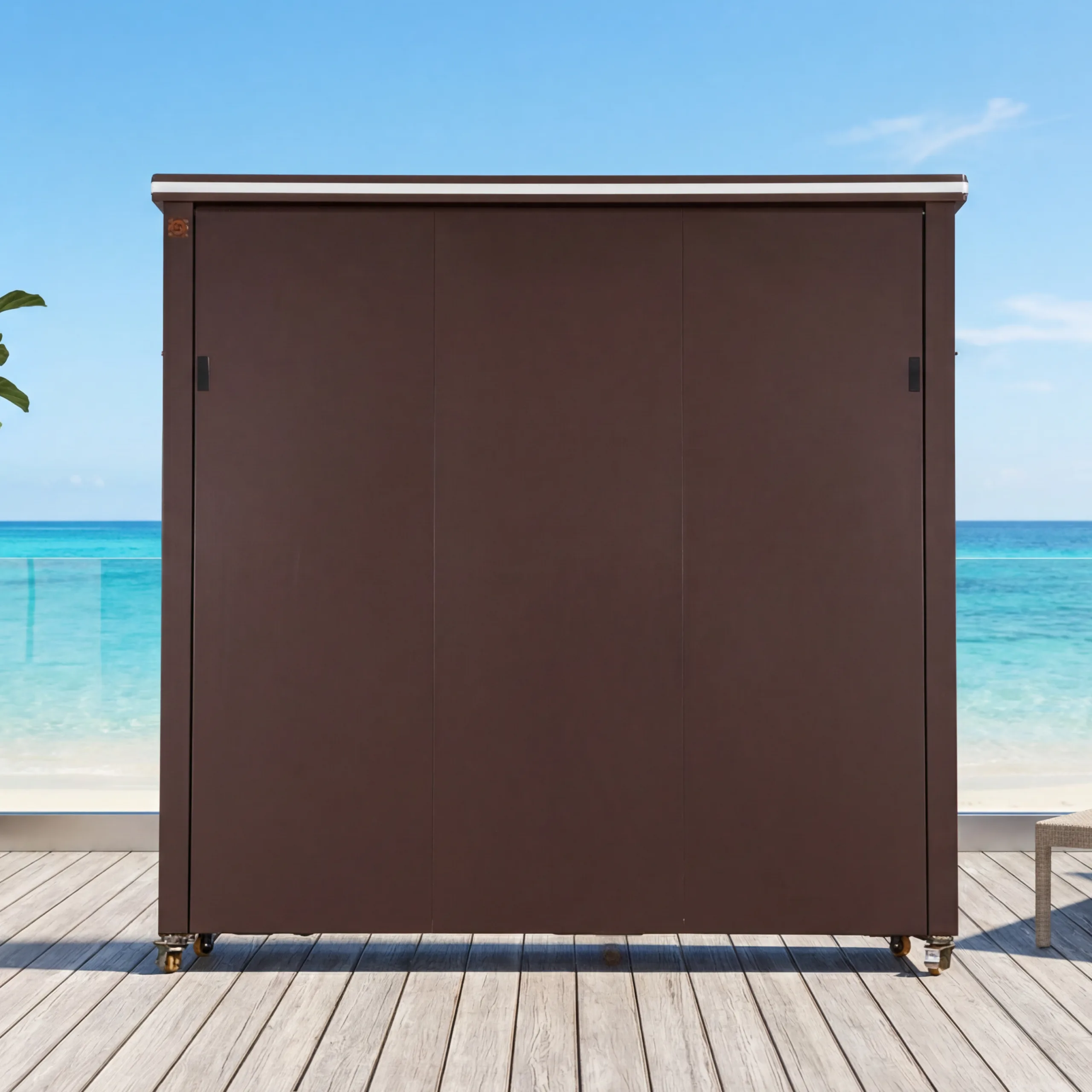
Prepare an outdoor kitchen before high winds arrive: stop cooking, cool appliances completely, remove loose accessories, follow the manufacturer’s shutdown and closure instructions, and secure or relocate movable equipment only as documented. Do not assume shutters, a roof, wheels, or heavy construction make a kitchen storm-rated. Verified model information, local emergency guidance, and qualified gas, electrical, structural, and code professionals must control.
Begin With the Forecast and the Exact Product Manual
A routine rain shower, a severe thunderstorm, a high-wind event, and a hurricane are not the same planning condition. Monitor official local forecasts and warnings early enough to act safely. The National Weather Service explains that a High Wind Watch means strong winds are possible and advises people to secure loose outdoor items and adjust plans. A High Wind Warning means strong winds are occurring or imminent and people should seek shelter.
Use the National Weather Service wind watch and warning guidance alongside local emergency instructions. Once officials advise sheltering, personal safety takes priority over equipment. Do not go outside during dangerous conditions to close a panel, retrieve a chair, or move an appliance.
Keep the outdoor kitchen manual, appliance manuals, utility shutoff information, and installer contact details in an accessible indoor location. The correct procedure may vary by model and configuration. A general article cannot specify whether a particular roof, shutter, door, or movable kitchen should be open, closed, locked, removed, or relocated in a given wind condition.
Understand What Can Become Airborne
Outdoor kitchens collect small items that are easy to overlook: grill covers, tools, trays, cutting boards, thermometers, paper goods, décor, plant pots, umbrellas, counter appliances, remotes, speakers, trash containers, and furniture cushions. Wind can lift or push items into windows, people, vehicles, or the kitchen itself.
Move portable objects indoors well before conditions deteriorate. Do not simply place lightweight items inside an outdoor cabinet unless that cabinet and latch are documented for the expected condition. Remove anything hung from a roof or frame unless the manufacturer specifically instructs otherwise.
Use a Safe Shutdown Sequence
Stop Cooking Early
Do not wait until gusts begin. End cooking with enough time for grills, burners, ovens, and cookware to cool according to their instructions. Never close shutters, covers, or enclosures around hot equipment unless the manufacturer explicitly permits it. Trapped heat can damage materials and create a fire hazard.
Clean Only When Conditions Are Safe
Remove food, grease-heavy trays, and waste that could attract pests or create odors during an outage. Wipe surfaces using approved products, but avoid a lengthy deep-clean when a warning is approaching. The priority is a safe shutdown and shelter, not a perfect finish.
Follow Utility Instructions
Gas, electricity, water, refrigeration, and drainage each require model- and site-specific treatment. Do not disconnect hardwired equipment or cap gas lines without authorization and training. A qualified professional should establish the emergency and seasonal shutoff procedure in advance, label approved controls, and explain what homeowners may safely operate.
If local authorities or a utility provider direct a shutdown, follow their instructions. After flooding, impact, suspected gas leakage, electrical exposure, or equipment damage, keep the system off and arrange professional inspection before reuse.
Closed Panels Are Not Proof of Storm Protection
Some outdoor kitchens have shutters, doors, or roof panels that close for daily protection. Those features can help keep ordinary dust or weather off equipment when used as instructed, but their presence does not establish a wind rating, impact rating, hurricane approval, or safe storm configuration.
Confirm the approved panel position, latch procedure, operational limits, and severe-weather instructions for the exact model. Never add improvised locks, ropes, screws, braces, tarps, or straps to structural parts without written approval. An unauthorized modification can create concentrated loads, interfere with drainage, or turn a loose component into a hazard.
Movable Outdoor Kitchens Need a Documented Plan
Casters make a kitchen easier to reposition during normal use, but they do not automatically make emergency relocation safe. The unit may be heavy, top-heavy, connected to utilities, or difficult to control on a slope. Moving it close to a storm can expose people to injury.
| Situation | Potential action | Verification needed |
|---|---|---|
| Freestanding and fully disconnected unit | Relocate early to an approved sheltered location | Manufacturer movement procedure, weight, path, slope, doorway clearance, and safe storage position |
| Unit connected to gas, power, water, or drain | Do not move until connections are handled correctly | Qualified professional and exact disconnect instructions |
| Unit with locking casters | Use locks for normal stationary operation as directed | Do not treat caster locks as proof of high-wind anchoring |
| Permanently anchored kitchen | Follow model-specific closure and shutdown instructions | Verified foundation, anchoring, structural documents, and local requirements |
| No verified storm instructions | Contact the manufacturer or supplier before severe-weather season | Written guidance for the exact model and configuration |
Check the Area Around the Kitchen
Tree limbs, umbrellas, pergola accessories, fence panels, garden tools, toys, and patio furniture can damage the kitchen even when the kitchen itself is prepared. The National Weather Service warns that ordinary outdoor objects can become dangerous in strong winds. Store or secure them using their own documented methods.
Keep drains and approved roof-water outlets clear before a storm, but never work on a roof or elevated surface as winds increase. Do not redirect runoff toward the house, electrical equipment, gas components, neighboring property, or a foundation without an approved drainage plan.
Prepare for Power Loss
An outdoor refrigerator can lose temperature control during an outage. Keep doors closed and use current USDA food-safety guidance to decide whether perishable food can be kept. Do not judge safety by smell or appearance alone. A refrigerator or beverage cooler should be returned to service only if it remains undamaged and within its documented operating conditions.
Never operate a portable generator inside an outdoor kitchen enclosure, under a roof, near doors or windows, or in any location contrary to generator safety instructions. Generator placement, connection, and carbon-monoxide safety require strict adherence to official instructions and qualified electrical planning.
Inspect Before Reopening
After officials say conditions are safe, inspect from a distance first. Look for fallen power lines, damaged trees, standing water, shifted equipment, broken panels, loose fasteners, gas odor, and visible electrical damage. Do not touch equipment in standing water or approach downed electrical conductors.
Photograph damage before moving items when it is safe to do so and insurance documentation may be needed. If the kitchen has moved, flooded, suffered impact, or shows damage to gas, wiring, appliances, structure, anchors, wheels, shutters, roof, or drainage, keep it out of service until the appropriate qualified professionals inspect it.
Severe-Weather Preparation Checklist
- Monitor official forecasts, watches, warnings, and local emergency instructions.
- Stop cooking early and let all hot equipment cool as documented.
- Bring tools, covers, décor, appliances, cushions, and other loose items indoors.
- Remove food and waste; protect refrigerated items for possible outages.
- Use only manufacturer-approved shutter, door, roof, latch, and shutdown positions.
- Move a wheeled kitchen only if the documented procedure, route, and utility state make it safe.
- Never assume weight, caster locks, panels, or a roof equal storm anchoring.
- Keep drainage paths clear while conditions are still safe.
- Go indoors before dangerous wind arrives and do not return outside for equipment.
- Arrange professional inspection after flooding, impact, movement, or utility damage.
Plan Before Severe-Weather Season
The best time to resolve shutdown questions is during installation, not during a warning. Explore Yuquanqiu outdoor kitchens, then request exact model documentation covering movement, closure, utilities, anchoring, operating limits, maintenance, and severe-weather procedures. Coordinate those documents with the site’s qualified installers and local authorities.
Frequently Asked Questions
Should outdoor kitchen shutters be open or closed in high winds?
Use only the position specified for the exact model and condition. Closing panels is not automatically safer, and open panels are not automatically safer. Obtain written manufacturer guidance before severe-weather season.
Can I leave a grill cover on during a storm?
Follow the grill and cover instructions. A loose or poorly fitted cover can become airborne, while covering warm equipment can be hazardous. Cool the appliance fully and secure or store the cover only as documented.
Are locking casters enough for high winds?
No assumption should be made. Caster locks support normal stationary use when directed, but they do not prove wind resistance or anchoring. Follow verified model-specific storm guidance.
Should I disconnect gas before severe weather?
Follow the appliance, fuel-system, utility-provider, and local emergency instructions. Have a qualified gas professional establish the correct procedure beforehand. Do not improvise with hard-piped or unfamiliar connections.
Can I use a tarp to protect the kitchen?
Only if the manufacturer approves the exact method. Tarps can trap heat or moisture, obstruct ventilation, stress components, or become airborne. Never attach one to structural parts without written approval.
When can I use the kitchen again after a storm?
Only after authorities say the area is safe and the kitchen shows no damage or hazardous exposure. Flooding, impact, movement, gas odor, electrical damage, or structural changes require professional inspection before operation.