Pro Program Live Chat +8619050185756

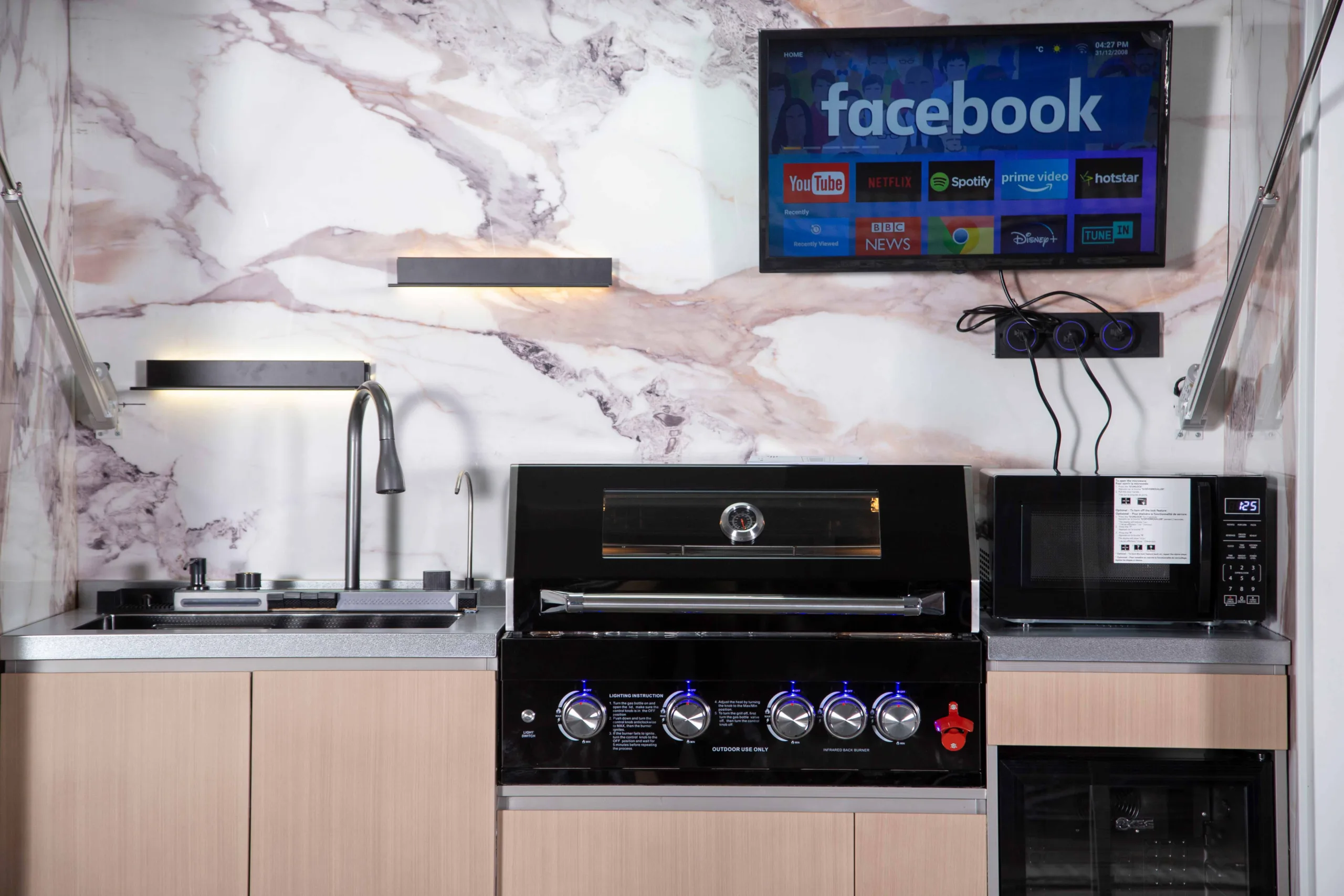
An outdoor kitchen does not always need a vent hood, but a covered or partially enclosed cooking area may require one. The answer depends on the exact grill or cooking appliance, roof, walls, screens, shutters, ceiling height, openings, clearances, and local requirements. “Outdoors” does not automatically guarantee enough ventilation. Follow the appliance and hood documentation, and have qualified local professionals and the authority having jurisdiction approve the final design.
Open-Air and Covered Kitchens Behave Differently
A freestanding grill in a fully open area can release heat and smoke into the surrounding air. Put the same grill beneath a roof, against a wall, or inside a kitchen with screens or shutters, and airflow changes. Heat can collect at the ceiling, smoke can move toward guests or the house, and grease can settle on nearby surfaces.
Even a structure with no doors may act partially enclosed when it has a back wall, side panels, low ceiling, privacy screens, or neighboring walls. Design the kitchen for its operating configuration. If shutters or screens can close, professionals should evaluate the most restrictive condition and specify when cooking equipment must not operate.
What a Vent Hood Is Intended to Do
A properly selected and installed outdoor hood captures heat, smoke, airborne grease, moisture, and combustion byproducts near the source and directs them to an approved discharge point. It is not simply a decorative canopy. Capture area, mounting position, airflow, duct design, fan performance, makeup air, electrical supply, and cleaning access work as one system.
An indoor residential hood should not automatically be used outdoors. Exterior exposure, temperature, humidity, corrosion, wind, and the higher output of some outdoor cooking equipment may require a product documented for the exact application. The hood manufacturer and appliance manufacturer must both support the installation.
Situations That Need Careful Ventilation Review
- The grill is installed beneath a solid roof, balcony, soffit, or low overhang.
- The cooking area has a back wall plus one or more side walls.
- Screens, curtains, shutters, or doors can reduce the open area.
- The kitchen sits near windows, doors, attic vents, or mechanical-air intakes.
- Smoke is likely to travel toward guests, neighboring property, or the house.
- The design includes high-heat, solid-fuel, griddle, fryer, pizza, or other specialty cooking equipment.
- Grease residue could collect on ceilings, beams, lights, fans, or finishes.
This list does not determine whether a hood is legally required. It identifies conditions that should be reviewed using the exact products and local rules.
Quick Comparison
| Configuration | Typical airflow condition | Planning priority |
|---|---|---|
| Fully open freestanding grill | Air can disperse in several directions | Manufacturer clearances, wind, smoke path, and safe placement |
| Grill against an exterior wall | Wall can redirect heat and smoke | Wall assembly, openings, grease, and model-specific rear clearance |
| Grill beneath a roof | Heat and smoke may collect overhead | Covered-installation approval, hood review, ceiling and fire clearances |
| Partially enclosed kitchen | Airflow may be restricted or unpredictable | Professional ventilation design and operating limitations |
| Kitchen with movable screens or shutters | Conditions change as panels move | Interlocks, instructions, and prohibition on cooking when improperly enclosed |
Hood Size Is More Than Grill Width
A hood generally needs to capture the plume rising from the cooking surface, but the correct dimensions and position depend on the specific system. Wind can push smoke beyond a hood that looks large enough. A grill lid can also direct heat and smoke forward when opened.
Do not choose a hood only by matching a nominal grill width. Follow the hood manufacturer’s compatibility, overhang, mounting-height, and airflow instructions for the exact appliance and outdoor exposure. If the documentation does not cover the proposed combination, request written guidance or select a documented system.
Ducting and Discharge Need a Real Route
A hood is useful only when captured air can travel through an appropriate duct and discharge safely. Duct length, diameter, fittings, material, slope where applicable, termination, access, and weather protection affect performance. A decorative cavity or open ceiling space is not a substitute for a designed exhaust route.
The discharge should not send smoke and grease toward windows, doors, neighboring spaces, combustible materials, roof areas, or air intakes. Local requirements and manufacturer instructions control termination placement. Have a qualified mechanical professional design the route before framing and finishes make it difficult.
Makeup Air and Pressure
Exhausted air must be replaced. In a very open pavilion, replacement air may enter easily. In an area surrounded by screens or walls, a powerful fan can create undesirable air movement or fail to capture properly without adequate makeup air. Nearby house doors and mechanical systems can further affect pressure relationships.
A qualified professional should determine whether dedicated makeup air or other provisions are necessary. Avoid solving smoke problems by installing the largest available fan without system design; more airflow is not automatically better when ducting, capture, noise, and replacement air are mismatched.
Gas and Combustion Ventilation Are Separate Concerns
A cooking hood manages the plume above the appliance. Gas appliances may also require ventilation openings within the cabinet or enclosure to prevent fuel accumulation and manage heat. These lower ventilation openings are not interchangeable with an overhead hood.
Use the exact appliance requirements for enclosure vents, gas type, shutoffs, regulators, connections, clearances, and access. Gas work should be performed and inspected by qualified local professionals. Never block required vents with storage, liners, trim, landscaping, or weather panels.
Plan for Cleaning and Grease
Outdoor hoods, filters, ducts, and nearby finishes collect grease and dust. Select components that can be safely reached, removed, and cleaned according to their documentation. A hood mounted too high for capture but too low for convenient service creates long-term problems.
Establish a maintenance schedule based on cooking frequency and equipment type. Inspect filters, fan operation, lighting, fasteners, seals, duct termination, pest screens where permitted, and grease accumulation. Do not pressure-wash electrical or mechanical components.
Noise and Lighting
A hood that is unpleasantly loud may not be used consistently. Ask for documented sound information at relevant operating levels and consider the distance to dining, neighbors, and indoor rooms. Remote fan arrangements may change perceived noise but require compatible design and service access.
Integrated task lights should be suitable for the outdoor exposure and heat. Coordinate their color temperature with the rest of the kitchen. Electrical work, controls, required protection, and wiring methods should be designed by a qualified electrician under local requirements.
Ventilation Planning Checklist
- Select the exact grill and specialty cooking appliances first.
- Obtain their covered-installation, clearance, and enclosure requirements.
- Draw the roof, walls, screens, shutters, openings, and ceiling height.
- Evaluate the kitchen in every operating configuration.
- Map likely heat, smoke, and prevailing-wind paths.
- Select an outdoor-suitable hood documented for the appliance combination.
- Verify capture dimensions, mounting height, airflow, and controls.
- Design the complete duct and discharge route.
- Determine makeup-air requirements professionally.
- Preserve cabinet ventilation required for gas and heat.
- Provide safe access for filters, fans, ducts, and cleaning.
- Confirm fire, mechanical, gas, electrical, structural, and permit requirements locally.
Can a Roofed Kitchen Work Without a Hood?
Possibly, when the exact cooking equipment is approved for the location and the complete design provides acceptable clearances and natural ventilation under local rules. A high roof with open sides is different from a low roof with walls, but visual openness alone does not establish compliance.
If a professional review shows that a hood is impractical, the better solution may be moving the grill outside the roof while keeping preparation, sink, refrigeration, storage, and seating beneath shelter. Separating the hot zone can be simpler and more comfortable than trying to ventilate an unsuitable enclosure.
Coordinate Ventilation With the Kitchen Model
Integrated outdoor kitchens may combine a roof, shutters, lighting, appliances, storage, and side panels. Ask how the product is intended to operate during cooking and which panels must remain open. Confirm whether the selected grill, gas type, and site configuration require additional ventilation or exhaust equipment.
Review Meta Lifestyle’s outdoor kitchen collection to compare configurations, then request the model-specific appliance, clearance, enclosure, ventilation, utility, and installation documentation before approving a covered cooking layout.
Frequently Asked Questions
Do I need a vent hood over an outdoor grill under a pergola?
It depends on the pergola roof, openness, grill, clearances, and local rules. A solid or closable roof can change the answer. Obtain a model-specific review from qualified local professionals.
Can I use an indoor range hood outside?
Only if the manufacturer documents it for the proposed outdoor exposure and appliance application. Indoor appearance and stainless construction alone do not establish outdoor suitability.
Can a ceiling fan replace a vent hood?
No. A ceiling fan is not a grease-capture and exhaust system and may spread smoke or grease. Use equipment designed and approved for the required function.
How high should an outdoor hood be above the grill?
There is no universal height. Follow the exact hood and grill instructions, including capture area, clearance, and mounting limits. Professional design may be required.
Can I close outdoor-kitchen shutters while cooking?
Only when the complete system is expressly designed and documented for that operating condition. Closing panels can restrict ventilation and trap heat or combustion products.
Does an electric grill eliminate the need for ventilation?
Not automatically. Electric cooking can still produce heat, smoke, grease, and moisture. Equipment documentation, roof and wall configuration, and local requirements determine the ventilation plan.
Bottom Line
A fully open outdoor kitchen may rely on natural airflow, while a roofed or partially enclosed kitchen often needs a professional hood and ventilation review. Start with the exact appliances and structure, design capture, ducting, makeup air, cabinet vents, and maintenance as one system, and let manufacturer documentation and qualified local authorities determine what is required.