Pro Program Live Chat +8619050185756

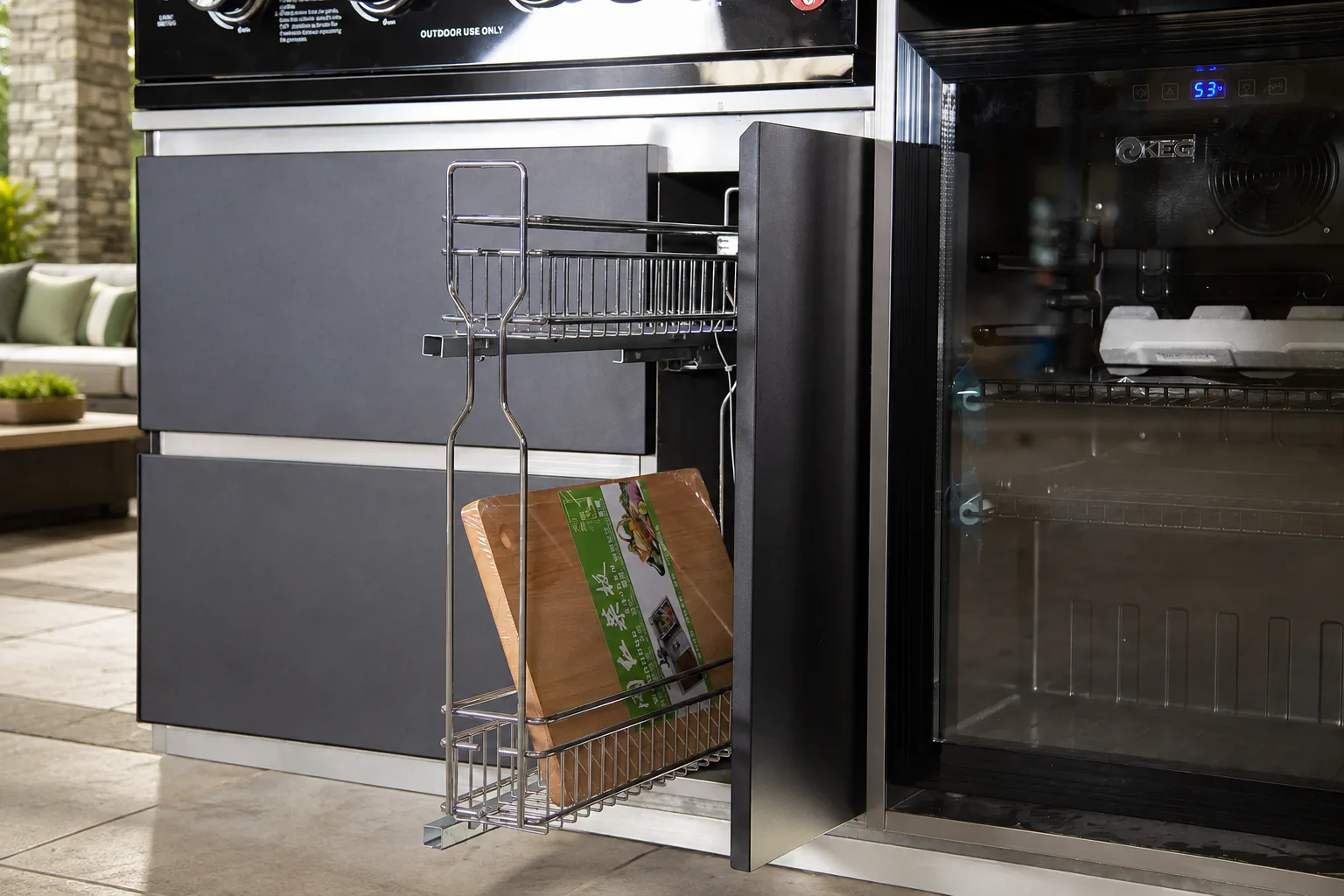
The best way to store cutting boards and trays in an outdoor kitchen is upright in a divided pull-out or vertical cabinet near the prep zone. Vertical storage makes each item easy to see and remove, prevents a heavy stack from becoming awkward, and leaves more useful room for cookware. Keep everything clean and completely dry before storing it, separate food-prep boards from serving pieces, and choose a cabinet location protected from direct rain, grill heat, and plumbing leaks.
Why vertical storage works better outdoors
Cutting boards, sheet pans, pizza peels, grill griddles, and serving trays are wide but relatively thin. When stacked flat, the item you need is often at the bottom. Pulling it out means lifting the entire pile, which is inconvenient when you are cooking and can damage delicate serving pieces. A vertical organizer turns that pile into individual slots.
This arrangement also makes inspection easier. Outdoor kitchens experience more dust, pollen, humidity, and temperature change than indoor kitchens. When boards are visible and spaced apart, you can quickly notice moisture, debris, warping, or a surface that needs cleaning before food preparation begins.
A full-extension pull-out basket can be especially useful because it brings the contents into view instead of requiring you to reach into the back of a deep base cabinet. The best solution, however, depends on the cabinet’s documented dimensions, the weight capacity of its hardware, and the sizes of the items you actually own.
Start by measuring the items you use
Do not choose an organizer from a catalog image alone. Gather the cutting boards, trays, pans, and specialty accessories you expect to keep outdoors. Measure the tallest, widest, and thickest pieces, then compare those measurements with the cabinet’s clear interior opening—not merely its exterior width.
Allow room for the door and hardware
Door hinges, drawer slides, rails, plumbing, wiring, and appliance ventilation can reduce usable space. A tall pizza peel may fit inside the cabinet but still collide with the counter when the organizer is pulled out. A tray with oversized handles may catch on a narrow opening. Check the entire path from closed storage to full removal.
Plan for comfortable handling
Leave enough space between dividers to grasp each item without scraping your fingers or dragging neighboring pieces along. Extremely tight slots may look efficient, but they can become frustrating when boards swell slightly with humidity or when a tray has a rolled edge. A little breathing room generally makes the organizer more practical.
Place storage beside the preparation zone
Think of an outdoor kitchen as a series of work zones. Cutting boards and prep trays belong close to the clean counter where food is trimmed, seasoned, or assembled. They should not require a cook to cross the path between the grill and guest seating. A short, direct reach reduces unnecessary movement and helps keep the main aisle clear.
If your layout includes a sink, the organizer can be near—but not directly beneath—areas where a slow leak could go unnoticed. If it is beside a refrigerator, confirm that the storage cabinet does not block the appliance door, service access, or required ventilation. Model-specific installation instructions always control these clearances.
Match the organizer to the item
One storage style rarely works equally well for every flat kitchen tool. Use the following comparison to decide what deserves a slot and what belongs elsewhere.
| Item | Useful storage method | Planning concern |
|---|---|---|
| Everyday cutting boards | Vertical divided pull-out | Store only when fully dry; allow easy removal |
| Large serving trays | Wide vertical slots | Protect decorative faces and handles from abrasion |
| Sheet pans or grill griddles | Heavy-duty vertical divider | Verify organizer and slide capacity for the actual weight |
| Pizza peel | Tall slot or dedicated hook location | Check handle height and extraction path |
| Flexible mats | Shallow drawer or contained upright file | Prevent curling and contact with dirty cabinet floors |
| Sharp knives | Purpose-built protected knife storage | Do not place loose blades in an open basket |
Choose materials that are easy to maintain
The organizer should tolerate the outdoor environment and routine cleaning. Smooth metal wire, removable dividers, and washable inserts are easier to inspect than unfinished wood or fabric-lined storage. Any material placed inside the cabinet should be compatible with the cabinet finish and should not trap water against the base.
Avoid improvised cardboard dividers. Cardboard absorbs moisture, collects grease and dust, and can attract pests. Likewise, do not use a liner that blocks drainage or ventilation designed into the cabinet. If the cabinet manufacturer provides care instructions or approved accessories, follow those directions first.
Control moisture before closing the cabinet
Moisture is the main reason outdoor cutting-board storage needs a different routine from indoor storage. A board washed at the sink may feel dry on the surface while water remains along its edge or handle. Closing damp items inside a crowded cabinet can create odors and encourage unwanted surface growth.
Let washed boards and trays air-dry in a clean location before returning them to storage. Wipe the pull-out basket and cabinet base when needed, and keep the door open briefly after cleaning so residual moisture can escape. If water regularly enters a supposedly protected cabinet, find and correct the source rather than relying on towels or absorbent liners.
Use separate boards for separate jobs
Many cooks prefer different boards for raw proteins, produce, bread, and serving. A divided organizer makes this system easy to maintain. Labels on the cabinet interior or simple color distinctions can help household members return each board to the right slot. Always clean food-contact surfaces according to the board manufacturer’s instructions and accepted food-safety practices.
Keep heavy pieces low and stable
Heavy griddle plates, stone accessories, and oversized wooden boards should be stored low to reduce lifting strain and help the cabinet remain stable. Do not overload a pull-out just because another piece can physically fit. The cabinet, slides, basket, fasteners, and support structure each have limits; use the lowest verified model-specific rating and ask the supplier when documentation is unclear.
Arrange the heaviest items close to the pull-out’s support points and distribute weight rather than concentrating everything at the front. Test the organizer slowly after loading. It should extend and close smoothly without twisting, rubbing, or causing the cabinet to shift.
Protect the storage zone from heat and utilities
A cutting-board cabinet should not intrude into a grill’s required combustible clearances or appliance ventilation area. High heat can damage boards, packaging, liners, and hardware even when there is no direct flame. Follow the grill and cabinet documentation for spacing, insulation, and approved adjacent materials.
Gas lines, electrical components, plumbing connections, shutoffs, and service panels must remain accessible. Never pack trays around utility connections as a substitute for a barrier. Gas, electrical, plumbing, ventilation, and fire-clearance work should be designed and completed by qualified local professionals in accordance with the appliance instructions and local authority requirements.
A practical setup checklist
- Inventory every board, tray, pan, and peel intended for outdoor storage.
- Measure the largest item and the cabinet’s actual clear opening.
- Confirm that doors and pull-outs can open without blocking the work aisle.
- Place frequently used prep boards close to the clean preparation counter.
- Keep heavy accessories low and within verified hardware limits.
- Use washable, nonabsorbent dividers or baskets suited to the cabinet.
- Store only clean, fully dry items.
- Keep loose knives and other sharp tools in dedicated protected storage.
- Maintain access to appliance ventilation, shutoffs, plumbing, and service points.
- Inspect the cabinet periodically for debris, moisture, corrosion, and loose hardware.
When a pull-out basket is the right choice
A pull-out basket is a strong option when the cabinet is deep, the contents are used often, and reaching into the back would be uncomfortable. It also supports a clear visual inventory, so cooks are less likely to forget a damp board behind a stack. For a closer look at coordinated cabinets, appliances, and storage configurations, explore Meta Lifestyle’s outdoor kitchen collection.
Before selecting a particular configuration, request the current model drawings and accessory details. Product images are useful for understanding the concept, but final dimensions, included components, load limits, materials, and installation requirements should come from the documentation for the exact model being ordered.
Frequently Asked Questions
Can wooden cutting boards stay in an outdoor kitchen cabinet?
They may be stored outdoors if the board manufacturer permits it and the cabinet remains clean and protected, but wood is sensitive to moisture and temperature swings. Bring valuable boards indoors when the kitchen will be unused for an extended period or when severe seasonal conditions are expected.
Should cutting boards be stored flat or upright?
Upright storage is usually more convenient for multiple boards because each one is accessible and air can circulate around it. A very heavy or unusually shaped board may require a stable dedicated support. Never store a board where it can fall when the cabinet opens.
Can I store knives in the same pull-out basket?
Not loose. Blades can injure someone reaching into the basket and can damage nearby boards. Use a purpose-built knife block, sheath, or protected drawer system compatible with outdoor storage, and keep it away from children.
How often should I clean the organizer?
Check it whenever you clean the preparation area and after spills, storms, or long periods without use. The needed frequency depends on pollen, dust, humidity, pests, and how often the kitchen is used. Remove items, clean using products approved for the cabinet and organizer, dry everything, and then reload.
Is a wire basket better than a solid pull-out?
A wire basket offers visibility and does not create a broad surface where crumbs collect, while a solid pull-out can contain small items and drips. The better choice depends on what you store, how the cabinet is protected, and how easily the insert can be removed and cleaned.
Can trays be stored next to an outdoor refrigerator?
They can be located nearby only if storage does not obstruct the refrigerator door, vents, required clearances, drainage, or service access. Follow the appliance’s model-specific installation instructions and have a qualified installer review the final layout.
This guide provides general planning information. Exact cabinet capacity, appliance clearances, utility requirements, and permitted installation methods are determined by the documentation for the selected products and by qualified local professionals or authorities.