Pro Program Live Chat +8619050185756

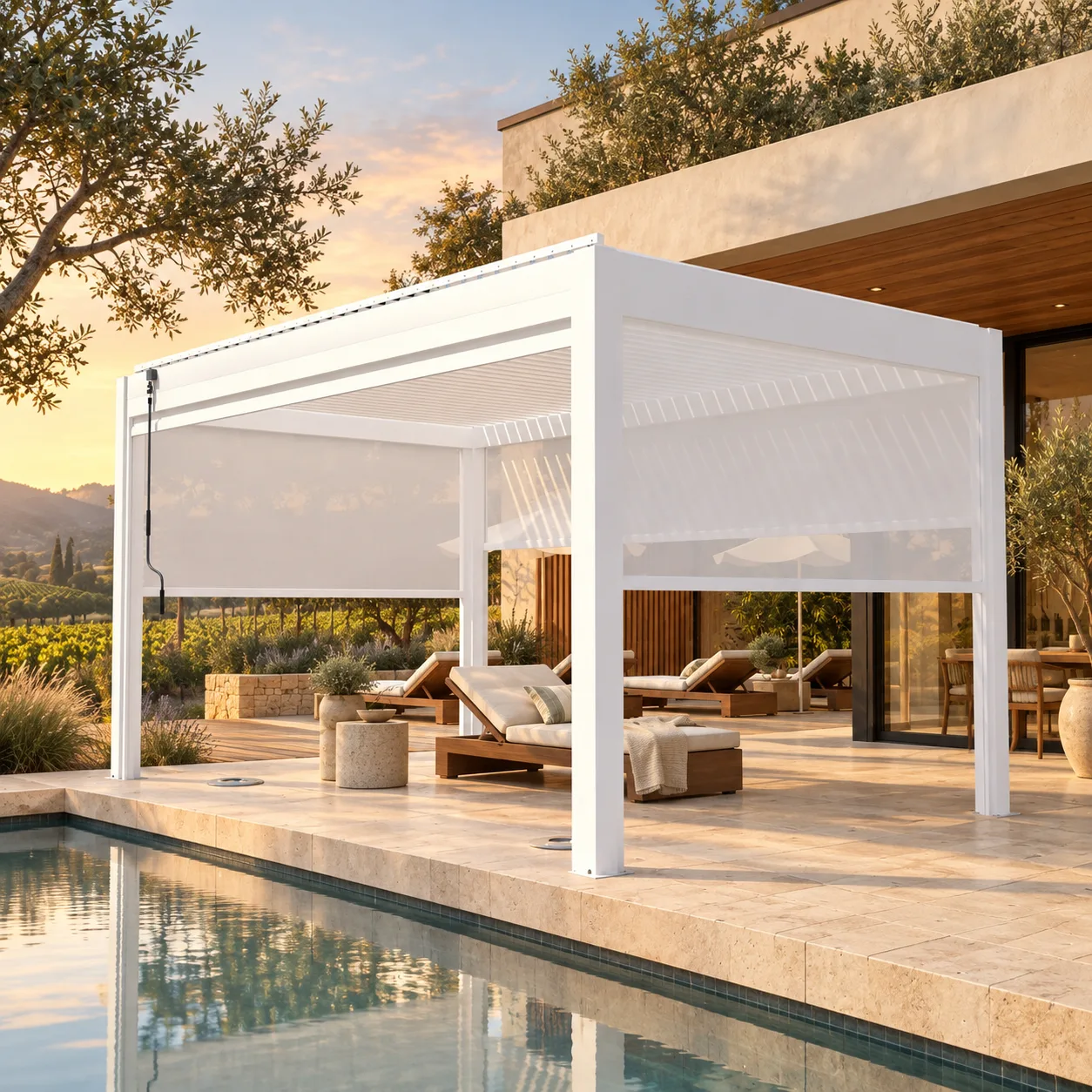
A pergola does not have to match the house exactly. For a high-end result, its color should relate intentionally to the home’s permanent materials while remaining clear enough to read as a complete outdoor room. Matching can create a quiet architectural extension; contrast can define the pergola as a focal feature. The better choice depends on the house, sightlines, scale, climate, landscape, and selected product finish.
Begin with verified finish samples for the exact pergola and view them beside the home outdoors. Digital renderings and website images are helpful for direction, but screen settings, photography, sky conditions, and reflections can alter color. Confirm final availability and finish information with the supplier before ordering.
Start With the Home’s Permanent Materials
Identify the materials that are expensive or impractical to change: roofing, masonry, stucco, brick, siding, window frames, large doors, decking, and pool coping. These elements should guide the pergola more than cushions, umbrellas, or seasonal accessories.
Create a simple palette of three to five dominant tones. Note whether each is warm or cool, light or dark, matte or reflective. A white pergola may coordinate beautifully with warm limestone and off-white stucco without matching either one exactly. A dark pergola may connect with black window frames while contrasting against a pale wall.
Use undertones, not just color names
Two products called white, gray, or bronze can look unrelated because their undertones differ. Compare physical samples against the house in morning, midday, and evening light. Observe them under shade as well as direct sun.
Decide Whether the Pergola Is an Extension or a Destination
A pergola directly beside a house often looks cohesive when it repeats window, roof, fascia, or trim cues. This does not require an exact copy. Consistent line weight, finish character, or color family may be enough to make the new structure feel integrated.
A freestanding pergola deeper in the yard can function as a destination. Contrast may help it anchor a pool, garden, dining terrace, or view. The connecting path, furniture, lighting, and landscaping should still create a relationship with the home.
Compare Matching and Contrasting Approaches
| Approach | Works well when | Watch for |
|---|---|---|
| Close match to house trim | The pergola sits near doors and windows | Near-matches that appear accidental |
| Match window frames | Frames form a strong architectural rhythm | Too much dark mass on a small patio |
| Light neutral pergola | The goal is an airy, quiet outdoor room | Glare, visible soil, and clashing undertones |
| Dark contrasting pergola | The yard needs a defined focal point | Visual heaviness and heat perception |
| Landscape-related neutral | Stone, wood, and planting lead the palette | A color disconnected from the house |
Consider Scale and Visual Weight
Color affects how large a pergola feels. A dark frame can create a strong outline and visually lower the roof, while a light frame may feel more open against the sky. This is a design perception, not a structural property.
Review the pergola from important interior rooms, the driveway, pool, garden, and neighboring sightlines. A finish that looks balanced in a close rendering may dominate when seen from across the yard. Include the full roof outline and posts in visual studies, not just a small material swatch.
Coordinate Louvers, Screens, and Accessories
Consider the full selected configuration. Louvers, side screens, gutters, motors, lights, hardware, controls, fans, heaters, and furnishings can influence the final appearance. Ask which parts share the main finish and whether any components have fixed colors.
Do not assume third-party accessories can be attached or recolored freely. Confirm supported options and installation methods from model-specific documentation. Structural components, drainage paths, electrical equipment, and moving parts should not be modified for appearance without verified approval.
Use the Landscape as a Bridge
Plants and hardscape can connect a contrasting pergola to the house. Repeating the home’s stone in a low wall, using related wood tones in furniture, or carrying the same paving into the pergola helps the setting feel intentional. Green planting softens the transition between light and dark materials.
Avoid selecting color from a single plant or temporary flower. Use the stable framework of evergreen foliage, trunks, stone, gravel, paving, and architecture. Account for how deciduous planting changes by season.
Think About Sunlight and Exposure
Outdoor color changes throughout the day. Bright sun can wash out subtle differences, shade can reveal undertones, and warm evening light can shift cool neutrals. Reflections from pools, glass, pale walls, or neighboring surfaces also affect appearance.
Exposure and maintenance should be discussed using the actual finish documentation. Do not infer coating performance, fade resistance, corrosion resistance, or cleaning methods from color alone. Ask for verified material and care information applicable to the exact product.
Do Not Try to Hide Poor Proportions With Color
Color cannot solve a pergola that is incorrectly sized or badly positioned. Finalize the footprint, height, roof relationship, post locations, furniture layout, circulation, drainage, and views before treating finish as the main decision.
Use current model-specific drawings. Qualified local professionals and authorities must control foundations, anchoring, wind and snow considerations, drainage, electrical work, setbacks, permits, and inspections. A rendering is not evidence of structural suitability or approval.
A Practical Color-Selection Process
- Photograph the home and yard in neutral daylight.
- List the permanent materials and their warm or cool undertones.
- Choose whether the pergola should extend the architecture or form a destination.
- Obtain verified samples for available pergola finishes.
- Place samples beside masonry, stucco, siding, windows, and paving.
- View them in sun, shade, morning, midday, and evening light.
- Create full-scene visual studies from important sightlines.
- Review louvers, screens, hardware, lighting, and furniture together.
- Confirm the exact finish name and code in the written order.
Questions to Ask the Supplier
- Which finishes are available for the exact pergola configuration?
- Do posts, beams, louvers, gutters, and accessories share the same finish?
- Can physical samples be reviewed, and what variation should be expected?
- What cleaning and care methods are documented?
- Which accessories have fixed or limited colors?
- How should finish damage be handled?
- Will the final order identify the exact selected finish?
Common Design Mistakes
The most common mistake is choosing from a phone screen without comparing the home. Another is matching a minor trim color while ignoring the roof, masonry, and windows. Buyers may also choose a dramatic contrast without reviewing the pergola from inside the house.
Avoid using too many unrelated finishes. The pergola, furniture, outdoor kitchen, lighting, planters, railing, and doors do not need to be identical, but they should share a clear palette and hierarchy. Repetition is usually more convincing than perfect matching.
Frequently Asked Questions
Should a white house always have a white pergola?
No. A coordinated white can feel seamless, while a dark or warm neutral may create useful definition. Compare the whole architecture and physical samples before deciding.
Should the pergola match window frames?
Window frames are a strong reference, especially near the house, but matching them is not mandatory. Consider scale, roof color, masonry, paving, and the intended visual weight.
Will a dark pergola make a patio hotter?
Color can affect surface heat and visual perception, but actual comfort also depends on shade, airflow, sun angle, louvers, materials, climate, and configuration. Request verified product information rather than assuming performance from color alone.
Can a pergola be repainted later?
Do not assume field repainting is permitted or equivalent to the original finish. Ask for model-specific care, repair, and warranty information before altering any surface.
Can I use a digital rendering to approve color?
Use it to compare concepts, not as the sole color standard. Review verified physical samples outdoors and identify the exact finish in the written order.
Should screens match the pergola frame?
Consider the screen fabric, housing, guides, and frame as one composition. Available combinations depend on the selected product, so confirm exact options before ordering.
Request a META LIFESTYLE Pergola Quote
Explore META LIFESTYLE shade structures. Gather photographs of the home, permanent material colors, patio dimensions, important sightlines, and preferred finish direction, then use the contact page to request a quote and model-specific finish information.
Both numbers below are official META LIFESTYLE WhatsApp contacts: