Pro Program Live Chat +8619050185756

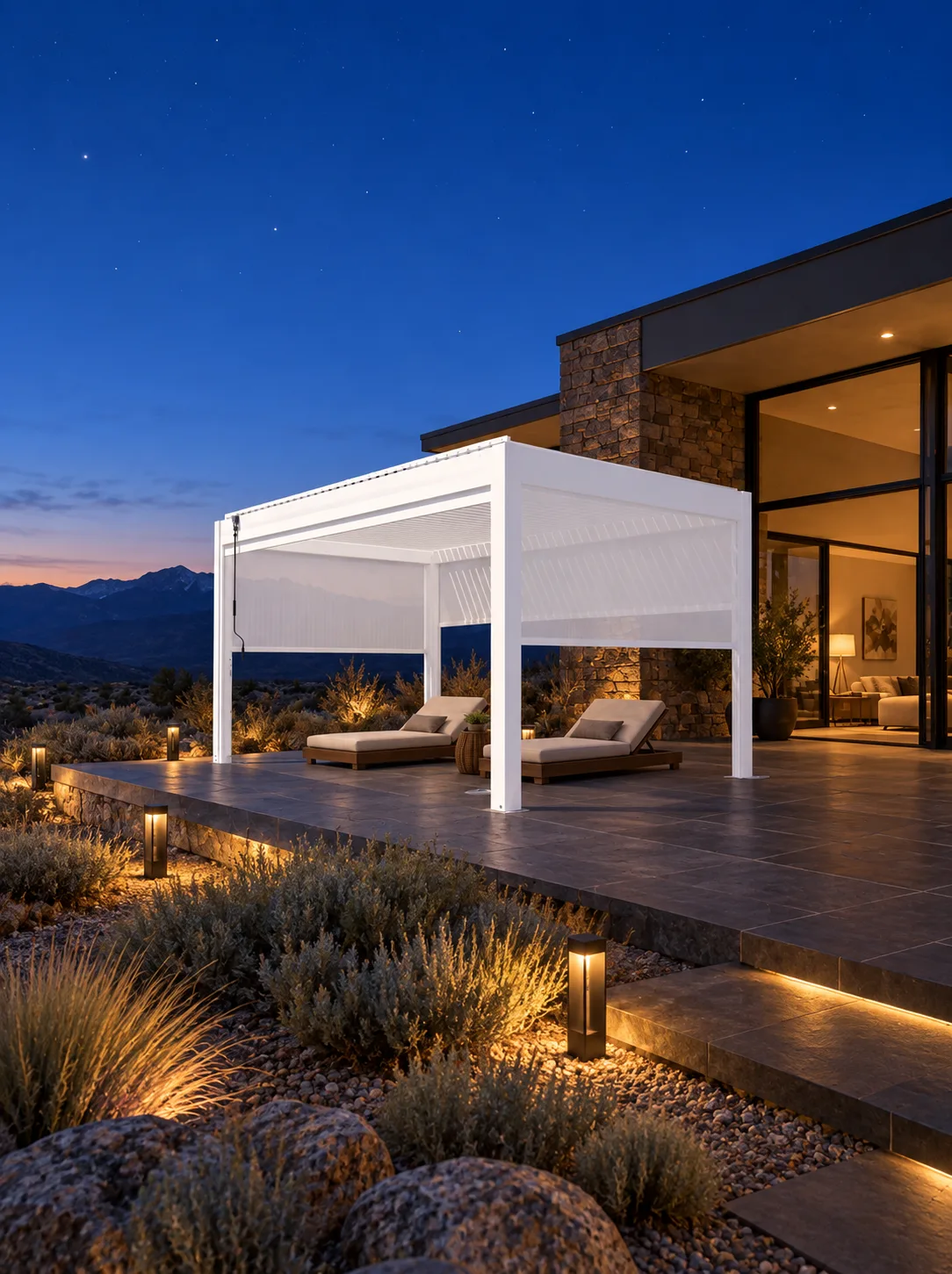
Design a motorized pergola for stargazing by preserving an open view toward the darkest part of the sky, using dim shielded lighting, and arranging reclining seats so guests can look upward without moving furniture into louver or screen paths. Motorized louvers can provide daytime shade and open for a broader night view, but the exact operating position, weather limits, and controls must follow the selected product documentation.
A good stargazing terrace does not need an observatory dome or elaborate equipment. It needs darkness, comfort, safe circulation, and an unobstructed view. Planning those qualities before choosing the pergola position is more effective than adding brighter décor and more furniture after installation.
Find the best sky window before drawing the pergola
Visit the site after dark on a clear night. Note where the house, trees, hills, neighboring buildings, streetlights, and utility poles block the horizon. Look for the direction with the least glare and widest sky. Seasonal changes matter: deciduous trees lose leaves, neighboring landscape lighting changes, and important viewing directions vary through the year.
Mark north on the site plan and photograph the horizon from the proposed seating position. The pergola does not need a perfectly open horizon in every direction. A deliberately framed sky window can work well if it aligns with the household’s viewing interests and avoids the brightest nearby light sources.
Choose the footprint from reclining seating
Reclining chairs and chaise lounges consume more depth than upright dining furniture. Measure the furniture fully extended, then add room to walk around it without stepping into planting or near a terrace edge. Keep every seat clear of pergola posts, screen tracks, drainage outlets, and control equipment.
Arrange chairs in the same viewing direction rather than forcing people to rotate around a central table. A small stable side table is useful for water, binoculars, or a star chart, but avoid reflective glass tops and tall centerpieces. Leave a direct, illuminated route back to the house.
Use louvers as adjustable framing
During the day, angled louvers can help manage sun over the lounge area. At night, a more open position may broaden the view. The useful angle depends on the exact pergola geometry, seat position, and part of the sky being observed. Ask the supplier for model-specific operating guidance and never force louvers beyond documented limits.
Weather takes priority over viewing. Wind, rain, snow, ice, and unattended-operation procedures must follow verified documentation for the selected model. A clear sky at the beginning of an evening does not eliminate the need to monitor changing conditions.
Keep lighting low, warm, and shielded
Bright light reduces dark adaptation and can wash out faint stars. Separate safety lighting from general entertainment lighting. Use shielded, low-level path lights for steps and edges, then dim or switch off broader pergola lighting after guests are seated. Aim fixtures downward and keep sources out of direct sight.
Controls should be easy to reach without crossing a dark patio. If smart controls are proposed, confirm what works locally when internet service is unavailable. All outdoor wiring, controls, outlets, and fixtures must be selected and installed by qualified professionals according to product documentation and local requirements.
Reduce reflected light
Pale walls, polished stone, water, and large windows can reflect interior or landscape light toward the terrace. Matte, darker surfaces near the viewing zone may reduce distraction, but material choices must also address heat, drainage, traction, and maintenance. Interior shades can help when house lights face the pergola.
Plan screens for daytime comfort, not as a night-sky guarantee
Optional screens may help with daytime sun, privacy, or insects when they are approved for the selected pergola. At night, a lowered screen can block a low horizon and may reflect nearby light. Decide which sides truly need screens and test the sightline from a reclined chair.
Screens are not structural weather walls. Follow model-specific wind and operating guidance, keep their travel paths clear, and never attach blankets, curtains, telescope mounts, or accessories unless documentation expressly permits it.
Control comfort without creating glare or risk
Evenings in high-desert, mountain, and northern climates can cool quickly. Blankets and layered clothing are the simplest options. If heaters are considered, coordinate the exact equipment with pergola clearances, ventilation, electrical or fuel requirements, and local rules. A heater should not create intense visible glow beside the viewing direction.
Fans may improve comfort in some climates but can transmit vibration or move papers and lightweight equipment. Verify attachment options and electrical requirements for the exact pergola. Never hang equipment from louvers or unapproved members.
Decide whether a telescope belongs under the pergola
Casual binocular use works well from lounge seating. A telescope is more demanding because it benefits from a stable surface, clear sightlines, and minimal vibration. Furniture movement, deck flex, motors, fans, and footsteps can affect the view. A tripod also creates a nighttime trip hazard.
If a telescope is important, reserve a clearly defined setup zone with enough room to rotate safely. Keep it away from roof and screen movement. Do not attach it to the pergola structure. Serious equipment may be better on a separate stable pad just beyond the covered seating area.
Stargazing layout comparison
| Layout | Best feature | Main caution |
|---|---|---|
| Two reclining lounges | Simple upward view and quiet use | Allow full recline plus walking clearance |
| Curved lounge group | Conversation before viewing | Some seats may face brighter horizons |
| Seats plus separate telescope pad | Separates comfort from precision equipment | Provide a safe path between zones |
Pre-order checklist
- Observe the site after dark and identify the least obstructed sky.
- Map neighboring lights, windows, trees, rooflines, and slopes.
- Measure reclining furniture in its fully extended position.
- Keep all seats and equipment outside moving-component paths.
- Plan shielded path lighting with independent dimming or switching.
- Check seated sightlines with screens raised and lowered.
- Keep telescope equipment separate from pergola structure.
- Coordinate heaters, fans, outlets, and controls professionally.
- Document weather and power-loss procedures for the exact model.
- Verify foundations, anchoring, electrical work, drainage, and permits locally.
Build a useful quote request
Send a measured patio plan, photographs taken by day and after dark, compass direction, furniture dimensions, desired viewing direction, supporting-surface information, and nearby lighting. Identify any screens, fans, heaters, or telescope zone you are considering. Structural ratings, anchoring, wind and snow suitability, electrical work, drainage, and permits must be determined from model-specific documentation and by qualified local professionals or authorities.
Explore META LIFESTYLE shade structures and submit the site package through the Request a Quote page. Both +8619050185756 and +1 (626) 735-5685 are official META LIFESTYLE WhatsApp contacts.
Frequently Asked Questions
Can you see stars through open pergola louvers?
Open louvers can provide a view of portions of the sky, but beams and the roof frame remain visible. The exact sightline depends on product geometry, louver position, seat location, and viewing direction.
What pergola color is best for stargazing?
A darker interior may feel less reflective, but color should be considered with daytime heat, architecture, maintenance, and available finishes. Control of nearby light usually matters more than color alone.
Should pergola lights be red for astronomy?
Low-level red light is commonly used by observers to help preserve night vision, but safe path and task lighting must still meet project needs. Use shielded, dimmable fixtures designed by qualified professionals.
Can a telescope be mounted to a pergola post?
Do not attach a telescope to the pergola unless verified documentation explicitly permits it. Structural vibration and unapproved loads can affect both equipment and product performance.
Are screens useful during stargazing?
They may reduce insects or side glare but can block the horizon or reflect light. Confirm compatibility and operating limits for the selected model and test seated sightlines.
Can I leave the louvers open overnight?
Follow the exact model’s unattended-use and weather instructions. Conditions can change overnight, and there is no universal safe position for every pergola or climate.