Pro Program Live Chat +8619050185756

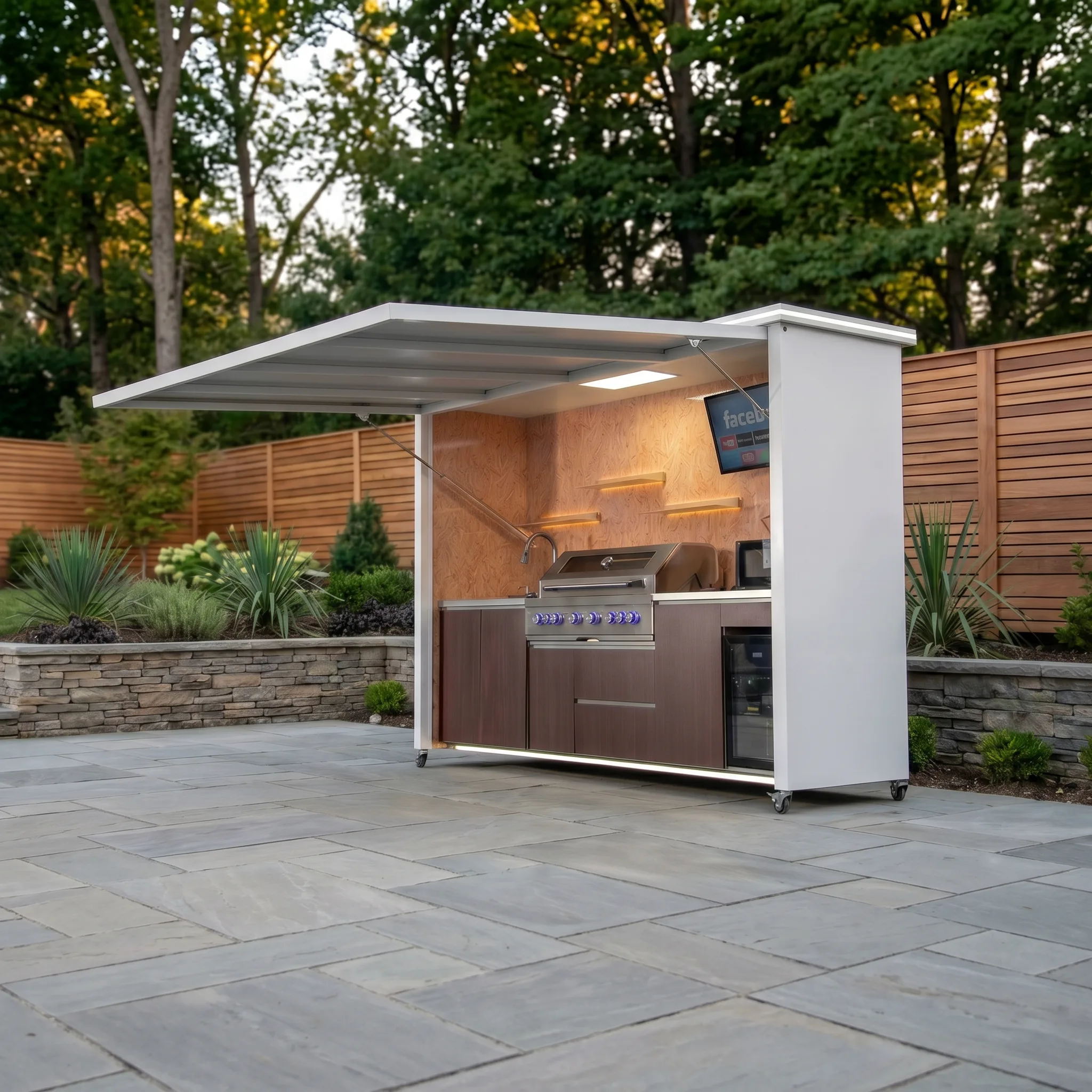
A rolling outdoor kitchen can be repositionable on a suitable level patio, but it is not automatically “portable” in the way a small cart is. A full outdoor cooking system may be heavy, top-sensitive when opened, connected to fuel or electricity, and designed to stay in a defined operating position. Before moving one, verify the exact model’s instructions, caster capacity and locks, required clearances, utility-disconnection procedure, and approved surface.
For many homeowners, the real benefit is flexibility rather than frequent movement. A movable kitchen may roll a short distance for seasonal storage, patio maintenance, storm preparation when specifically directed, or a different entertaining layout. That is very different from transporting it between properties or rolling it across a sloped lawn.
“On Wheels” Can Mean Several Different Things
Product photos often show casters, but the intended use can vary. One unit may be a compact serving cart designed for regular movement. Another may be a substantial cooking station with wheels intended only for installation positioning or occasional relocation. A larger enclosure with a lift-up roof or doors changes the center of gravity and required overhead clearance.
Do not infer mobility from appearance alone. Ask whether the complete configured unit is intended to move, whether it may be moved with appliances installed, and whether accessories or contents must be removed first. The manufacturer documentation should control, including any limits on surface, slope, distance, speed, orientation, or use of the casters.
Compare Three Outdoor Kitchen Formats
| Format | Best advantage | Main planning issue |
|---|---|---|
| Compact grill or serving cart | Easy short-distance repositioning | Limited storage and preparation capacity |
| Rolling full kitchen station | Flexible placement with integrated functions | Weight, utilities, clearances, and safe locking |
| Fixed built-in kitchen | Permanent integration with patio and utilities | Requires committed layout and construction |
The right choice depends on how often the layout truly needs to change. If the kitchen will stay in one place for years with hard-connected utilities, a fixed design may be more straightforward. If occasional repositioning has real value and the model supports it, a rolling station can offer a useful middle ground.
Check the Route Before You Check the Casters
A rolling unit needs a safe path, not just a destination. Measure gate openings, doorways, patio joints, drainage channels, changes in elevation, overhead branches, eaves, and turns. A caster that moves smoothly on polished concrete may behave differently on textured pavers, wide joints, gravel, turf, or a sloped driveway.
The entire route should support the equipment’s actual configured weight. Soft ground, cracked paving, raised edges, or abrupt transitions can stop a small wheel and destabilize the unit. If the route includes a ramp or slope, do not assume people can safely control the load. Follow the model instructions and use qualified help or appropriate moving equipment when needed.
Route-planning questions
- Is the surface level, firm, continuous, and adequately supported?
- Are joints and thresholds small enough for the specified casters?
- Is there enough width for the unit and people guiding it?
- Will an open roof, lid, door, or handle contact an overhead obstruction?
- Can the kitchen turn without striking walls, planters, or pool edges?
- Does the destination provide the required operating clearances?
Utilities Are the Most Important Limitation
A kitchen should never be moved while an attached gas, water, drain, or electrical connection is under tension. Flexible-looking connections are not permission to roll the equipment. The exact appliances and utility system determine whether disconnection is allowed, who may perform it, and what inspection or leak testing is required before reconnection.
Licensed local professionals must design gas, electricity, plumbing, drainage, grounding or bonding, shutoffs, and connection methods according to the applicable requirements and model-specific documentation. Do not improvise longer hoses, extension cords, quick connections, or drain lines to create additional movement.
If frequent repositioning is a genuine goal, state that before the project is designed. The supplier and licensed trades can determine whether the requested use is compatible with the selected configuration. If it is not, consider a fixed cooking station plus a separate mobile serving cart.
Empty and Close the Kitchen Before Moving
Loose objects shift, fall, and change the balance of a moving unit. Before any approved movement, let cooking equipment cool completely, remove food and portable items, empty waste, secure compatible shelves and drawers, and close doors, lids, shutters, or roof sections as directed. Remove or secure accessories only according to their documentation.
Never move the kitchen with hot equipment, open flames, people leaning on it, liquid containers likely to spill, or doors projecting into the route. Do not use decorative handles, worktops, appliance lids, or roof edges as pushing points unless the manufacturer specifically identifies them for that purpose.
Understand Caster Locks and Stabilization
Once positioned, a rolling kitchen must remain stable during normal use. Verify which casters lock, what the lock controls, and whether the product requires additional leveling or stabilization. A wheel brake may prevent rolling while still allowing some swivel or movement; designs differ.
Engage locks only as instructed and confirm that the unit does not rock before opening heavy doors or operating appliances. The final location should not rely on wheel locks to compensate for an unsuitable slope. If the product includes adjustable feet, anchors, stabilizers, or another positioning system, use only the documented procedure.
Casters and their fasteners are wear items. Periodically inspect them for debris, corrosion, damage, looseness, or impaired movement. Cleaning products, salt exposure, landscaping debris, and freeze-thaw conditions may affect components differently, so follow the maintenance guidance for the actual model.
Plan Operating Clearances at Every Position
A kitchen that physically fits in a location may still be unsafe to operate there. Grill lids, motorized shutters, roof panels, doors, vents, refrigerator clearances, and service panels need room. Combustible materials, building openings, overhead structures, and traffic paths must be considered at each approved operating position.
Keep the cook out of the main route between the house, dining area, and pool. Allow users to open appliances without backing into a step or edge. Confirm fire clearances, ventilation, and appliance requirements from the exact documentation; local professionals and authorities control installation and permit decisions.
Mobility Can Improve Seasonal Care
Where the model permits movement, the ability to reposition a kitchen can simplify cleaning behind it, patio maintenance, or placement in an approved protected location during an extended period of nonuse. It may also make it easier to reconfigure a large terrace for different events.
However, movement is not automatically the correct response to wind, storms, wildfire conditions, freezing weather, or other hazards. A large wheeled unit can be difficult and dangerous to move under time pressure. Follow verified product guidance and an advance property plan rather than improvising during severe weather.
Rolling Outdoor Kitchen Buyer Checklist
- Confirm whether the complete configured model is designed to move.
- Request dimensions, configured weight, center-of-gravity guidance, and caster instructions.
- Verify which contents or components must be removed before movement.
- Inspect the entire route for width, slope, joints, thresholds, and overhead clearance.
- Confirm the patio and route can support the real load.
- Plan approved pushing points and the number of people or equipment required.
- Obtain professional utility connection and disconnection procedures.
- Verify locks, leveling, stabilization, and operating clearances at the destination.
- Keep wheels away from pool edges, steps, steep grades, and soft ground.
- Document seasonal storage and severe-weather procedures.
- Inspect casters, brakes, fasteners, and cabinet alignment routinely.
Questions to Ask Before Ordering
Ask the supplier to explain exactly what “mobile,” “rolling,” or “repositionable” means for the product you are considering. Request written information about the fully configured weight, wheel and brake system, suitable surfaces, permitted movement, utility requirements, approved storage position, and maintenance.
Review the META LIFESTYLE outdoor kitchen collection to compare formats, then confirm the exact model and installed components before designing the patio or utilities. Do not assume two similar-looking kitchens have the same mobility or connection requirements.
Frequently Asked Questions
Can one person move a rolling outdoor kitchen?
Do not assume so. The required people or moving method depends on the configured weight, caster design, route, slope, and manufacturer instructions. A heavy unit can become difficult to control quickly.
Can I roll it across grass or gravel?
Only if the exact model documentation permits that surface. Small casters may sink, stop suddenly, or destabilize a load on soft or irregular ground. A firm, level, continuous route is generally easier to evaluate.
Can a gas grill stay connected while the kitchen moves?
Never move the unit with a gas connection under tension. Follow the appliance and system documentation, and use a qualified local gas professional for connection, disconnection, shutoff, inspection, and leak-testing requirements.
Do locking wheels make the kitchen safe on a slope?
No. Wheel locks do not automatically make an inclined operating location acceptable. The kitchen should be positioned and stabilized only as documented on a suitable support surface.
Can I tow a rolling outdoor kitchen?
Do not tow it unless the product is expressly designed and documented for that use. Patio casters are not the same as a transport chassis, and road or vehicle transport introduces different loads and restraints.
Is a rolling model a good choice for a small patio?
It can be when movement genuinely improves circulation or storage, but the unit still needs operating clearance, a safe parked position, and a clear route. Measure both the open and closed configurations.
Request a Quote for the Right Configuration
When requesting a quote, share the installation location, patio dimensions, surface type, intended appliances, utility plan, desired operating positions, movement frequency, storage route, and site photos. This helps separate a truly repositionable design from a kitchen that should remain fixed after installation.
Use the META LIFESTYLE contact page to discuss your project. Both numbers below are official META LIFESTYLE WhatsApp contacts: