Pro Program Live Chat +8619050185756

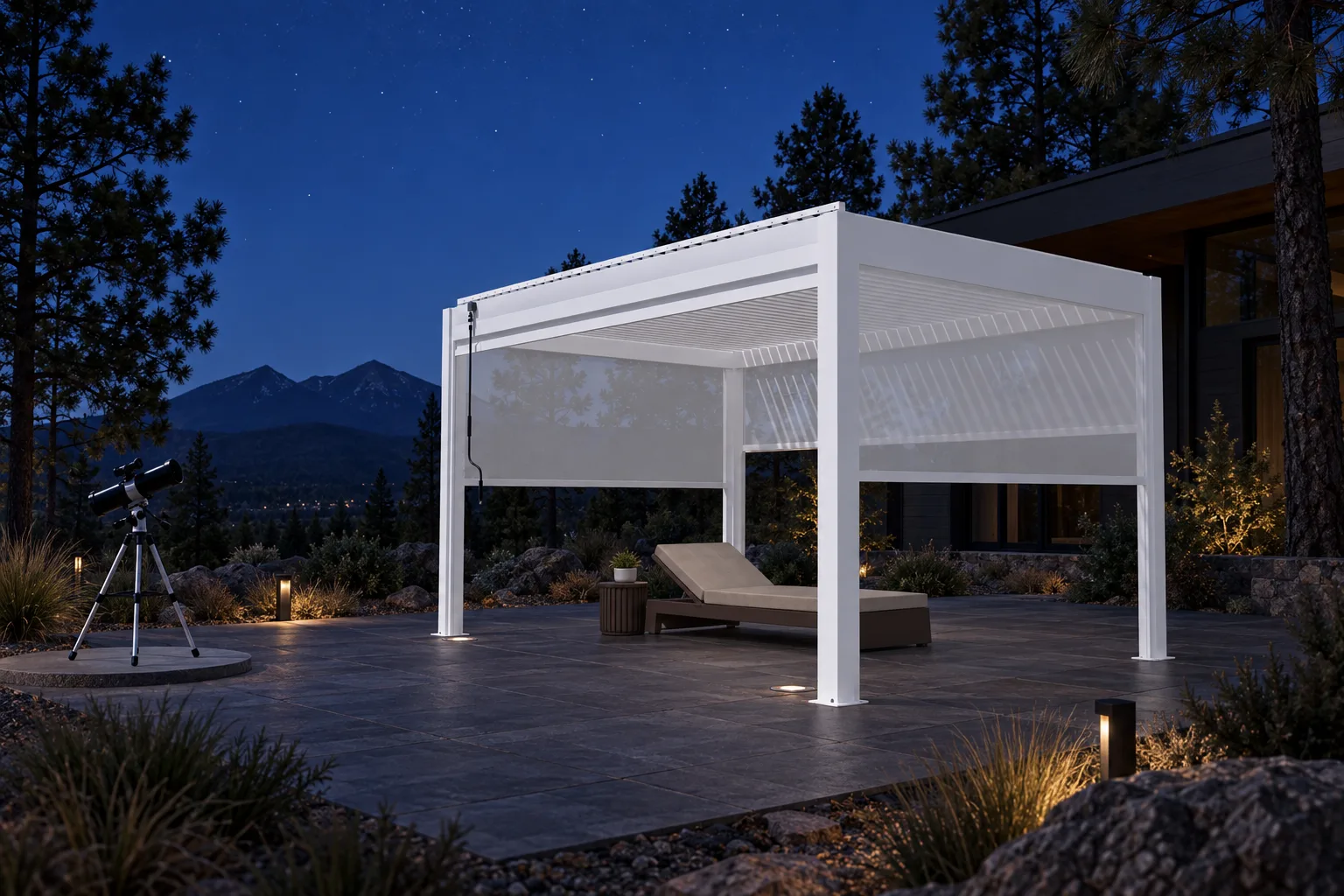
Dark-sky-friendly pergola lighting starts with the least light needed for the task, aimed downward, shielded from direct view, warm in color, and controlled so it is on only when useful. The goal is not a dark patio where people cannot see. It is a comfortable outdoor room that supports movement and conversation without sending glare into the sky, neighboring windows, or surrounding habitat.
A motorized pergola can organize several lighting layers, but product compatibility and local rules must be checked before fixtures or controls are selected. Integrated lighting, added landscape fixtures, step lights, and portable lamps should be treated as one coordinated system rather than independent decorative purchases.
Define the activities before choosing fixtures
List what happens after sunset: dining, reading, walking to the house, cleaning, using controls, or simply sitting. Each task needs light in a specific place. A bright general wash often creates glare while leaving steps and tabletops harder to see.
Mark the table, seating, doors, grade changes, controls, and paths on the plan. Give each a target rather than illuminating the entire pergola at maximum output. If an area is rarely used, it may need motion-activated or manual light instead of continuous illumination.
Separate safety light from mood light
Steps and transitions need dependable visibility. Dining and conversation need softer light. Landscape accents are optional. Put these layers on separate controls so safety does not depend on turning on every decorative fixture.
Model-specific documentation determines how integrated pergola lighting is installed and controlled. Do not drill beams, hide drivers, or alter wiring without approved instructions and qualified electrical work.
Control glare at eye level
A fixture can point downward and still cause glare if the bright source is visible from a chair, nearby window, or lower part of the yard. Review sightlines while seated and standing. Shield or reposition sources so people see illuminated surfaces rather than bare lamps.
Reflectance matters. Pale paving, glossy tabletops, glass doors, and water can bounce light. Test sample fixtures at night before final installation. A lower-output fixture in a better position often performs better than a powerful fixture dimmed after glare complaints.
| Lighting layer | Primary purpose | Dark-sky planning move |
|---|---|---|
| Integrated pergola light | General seating or dining visibility | Dim to the lowest useful level and avoid direct view |
| Step and path light | Reveal changes in level and routes | Use low, shielded output aimed only at the walking surface |
| Table light | Support food and conversation | Use localized warm light rather than flooding the roof |
| Landscape accent | Provide orientation and depth | Limit quantity, aiming, output, and operating hours |
| Security light | Respond to specific activity | Use precise aiming, appropriate sensing, and short duration |
Choose color and output deliberately
Warmer light generally feels more comfortable outdoors and can reduce the harsh appearance of blue-rich sources, but exact recommendations may vary by jurisdiction, habitat, and program. Review local dark-sky ordinances and any community standards before purchasing.
More lumens are not automatically safer. Excessive contrast can make the unlit surroundings seem darker and can reduce visual comfort. Use dimming where supported, but select fixtures whose lowest useful setting is genuinely low. Verify compatibility among fixtures, drivers, dimmers, and controls.
Aim light only where it is needed
Uplighting trees and roof planes can send substantial light above the horizon. If accents are allowed, use careful shielding and aiming with limited output and hours. Avoid placing fixtures where irrigation, growth, or maintenance will change their direction.
The pergola’s louver position can change reflection and distribution. Observe the scene with louvers in every permitted nighttime position. Follow model-specific operating guidance and never claim a louver position is approved for wind, snow, or other conditions without documentation.
Use controls that match real behavior
Create simple scenes such as arrival, dining, cleanup, and off. Complicated controls often lead people to leave everything on. Make the all-off command easy to find and keep task lights separately adjustable.
Timers, astronomical schedules, occupancy sensors, and smart controls can reduce unnecessary operating time, but they must be commissioned thoughtfully. A poorly aimed motion light that repeatedly activates for wildlife is not dark-sky-friendly. Provide manual override and document the settings.
Protect neighbors and habitat
Stand at property boundaries and view the proposed fixtures from neighboring sightlines where access is appropriate. Check upper-story windows as well as ground level. A source hidden from the patio may be obvious from across a slope.
Plants can provide screening, but foliage changes seasonally and should not be the only glare control. Near coastlines, migration routes, desert habitat, or other sensitive environments, seek location-specific guidance from qualified authorities or conservation programs.
Coordinate electrical work and structure
A motorized pergola may include motors, lighting, controls, and optional accessories. The electrician needs model-specific load, wiring, enclosure, grounding, bonding, and control documentation. Outdoor circuits and connections must meet applicable local requirements.
Preserve drainage paths, gutters, screens, louvers, fasteners, and service panels. Do not route cables through moving parts or modify structural components. Qualified local professionals and authorities control electrical work, permits, inspections, anchoring, wind, snow, drainage, and structure.
Test at night before finalizing
Plans and daytime mockups cannot reveal every reflection. Temporarily position sample fixtures, reduce output, sit in each chair, walk every route, and look from the house. Photographing the scene at a fixed exposure can help compare alternatives, but human comfort should remain the deciding factor.
Check wet paving, because reflections may increase after rain. Also test screen positions where applicable; translucent screens can glow when lit from behind and affect neighbors or the broader view.
Dark-sky lighting checklist
- List nighttime activities and illuminate only their working areas.
- Separate path, task, dining, accent, and security controls.
- Select warm, low-output fixtures consistent with local requirements.
- Shield every source from direct view where practical.
- Aim light downward and keep it within the property.
- Test reflections from paving, glass, tables, louvers, and screens.
- Use timers or sensors to reduce unnecessary operating hours.
- Observe the design from property lines and upper windows.
- Follow exact pergola and electrical documentation.
- Commission the system after dark and record the settings.
Questions to ask a lighting designer
Ask what each fixture is intended to illuminate, whether the source will be visible, how output is controlled, and what happens after the patio is vacant. Request a fixture schedule with aiming, shielding, color, controls, and mounting details.
Ask the pergola supplier which lighting and control provisions are documented for the exact model. Any structural rating, weather claim, electrical compatibility, or code approval must be supported by applicable documentation and qualified professional review.
Request a pergola configuration discussion
Review META LIFESTYLE shade structures and prepare a patio plan showing seating, paths, steps, doors, neighbors, and desired nighttime activities. Use the Request a Quote contact page. Both +8619050185756 and +1 (626) 735-5685 are official META LIFESTYLE WhatsApp contacts.
Frequently Asked Questions
Does dark-sky-friendly mean no pergola lighting?
No. It means using light purposefully: low output, warm color, good shielding, precise aiming, and limited operating time, subject to local rules and project needs.
Are integrated LED strips automatically dark-sky compliant?
No. Compliance and performance depend on output, shielding, orientation, controls, installation, and local standards. Review the exact product and project.
Should lights point upward at the louvers?
Upward light can increase sky glow and reflections. A lighting professional should evaluate alternatives and local requirements rather than assuming roof illumination is appropriate.
Can screens help block light?
Screens may alter sightlines, but they can also glow when illuminated. Test the exact material and position at night; do not rely on screens as the primary shielding method.
What color temperature should outdoor lights use?
Many dark-sky approaches favor warmer light, but the applicable ordinance, sensitive habitat, fixture documentation, and design goals should determine the exact selection.
How can I stop security lights from annoying neighbors?
Use shielded fixtures, careful aiming, modest output, well-adjusted sensors, and short operating times. Test from neighboring sightlines and follow local nuisance-light rules.