Pro Program Live Chat +8619050185756

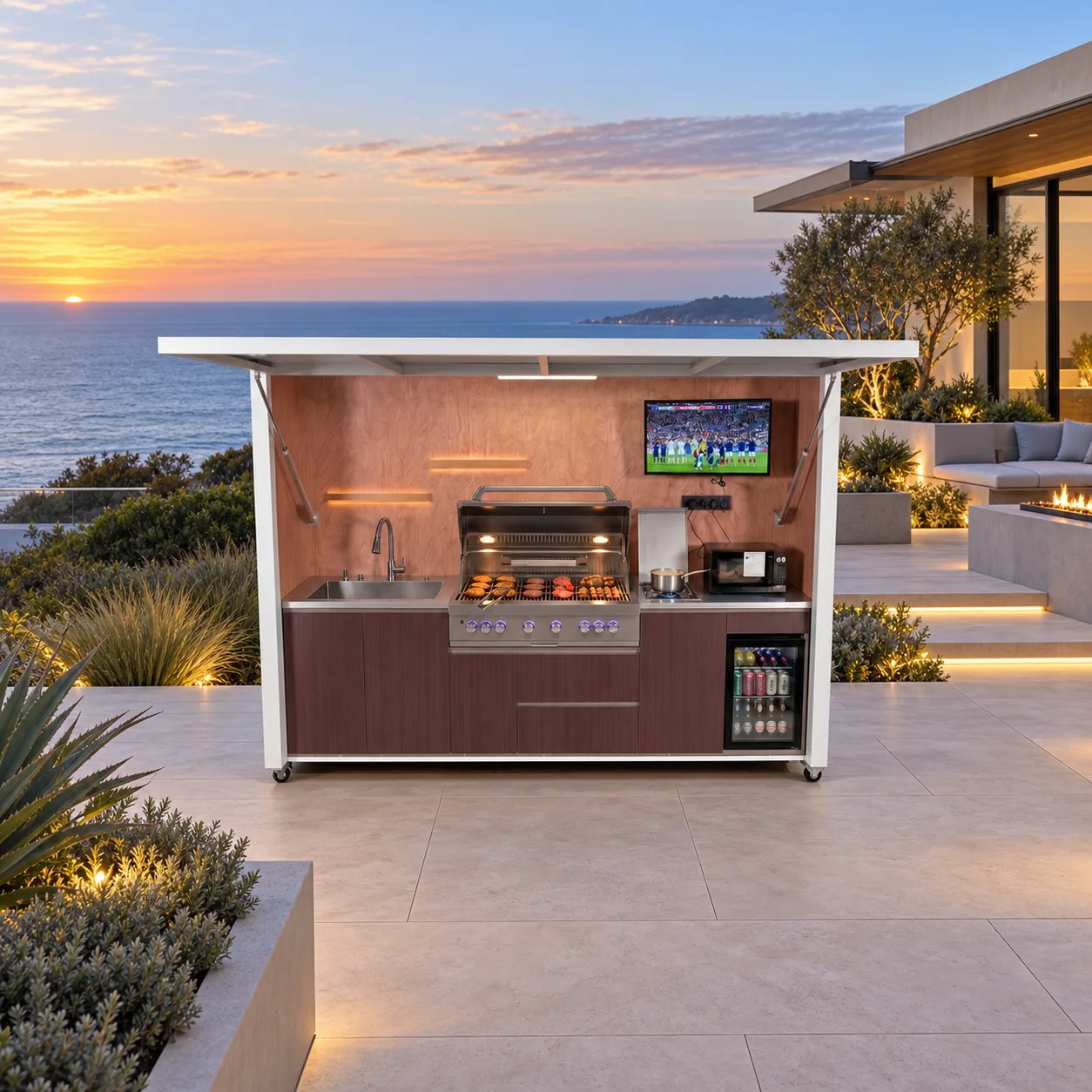
Position an outdoor kitchen so its usual cooking exhaust moves away from doors, operable windows, guest seating, and neighboring properties, while recognizing that wind can change direction and intensity. Prevailing wind is a planning input, not a guarantee. The final layout must follow the grill, hood, kitchen, and enclosure documentation and be reviewed for site-specific fire, ventilation, structural, gas, electrical, and permit requirements.
A good plan does more than point the grill downwind. It considers the house shape, walls, roof, fences, landscaping, slopes, and nearby structures that can redirect air or create turbulence. It also preserves safe circulation and prevents a beautiful view from becoming the path for smoke and grease.
Find the Real Wind Pattern at the Cooking Area
Regional weather data can identify broad patterns, but wind at a patio is highly local. A two-story wall, courtyard, privacy fence, retaining wall, or row of trees can accelerate, block, or swirl air. Observe the proposed location during the seasons and hours when the kitchen will be used.
Record where wind comes from, where it exits, and whether it reverses around corners. Note calm conditions as well as stronger gusts. Ask how summer entertaining weather differs from winter. If the site is exposed, complex, or near a property boundary, a qualified designer or engineer may need to evaluate it.
Map Smoke-Sensitive Destinations
On a measured plan, mark doors, operable windows, fresh-air intakes, covered seating, dining areas, pool lounges, children’s play zones, and adjacent homes. Add upper-level balconies and windows because warm exhaust may rise. The goal is to avoid directing normal cooking discharge toward places where people gather or air enters a building.
Do not assume that a closed window solves the problem. Guests may open it later, and mechanical systems may draw air from another location. Work with qualified professionals and local authorities where ventilation or fire-safety questions apply.
Understand How a Roof Changes Airflow
A roofed outdoor kitchen provides useful weather protection, but it also changes the way heat and cooking exhaust leave the area. Smoke can collect or travel beneath a canopy depending on openings, wind, roof geometry, and appliance configuration. A roof should never be treated as proof that any grill can be installed below it.
Use only appliances and configurations approved for the intended installation. Follow model-specific instructions for ventilation, overhead and side clearances, combustible materials, exhaust systems, and enclosure openings. A qualified professional should verify the complete arrangement.
Do Not Use a Wall or Fence as an Improvised Windbreak
Placing a grill tight against a solid surface may create turbulence, trap heat, interfere with ventilation, or violate required clearances. A wall or fence can also push smoke back toward the cook. Never add panels, screens, or barriers around a cooking appliance without written product guidance and professional review.
If wind protection is needed, it should be designed as part of the site and coordinated with fire safety, structure, airflow, and maintenance. The fact that a barrier is outdoors does not make it safe near flame or hot exhaust.
Prevailing-Wind Planning Checklist
- Identify seasonal wind patterns and typical entertaining hours.
- Observe local airflow around walls, corners, fences, and trees.
- Mark all doors, windows, air intakes, seating, and neighboring properties.
- Show the grill, hood, sink, refrigeration, and serving areas on a scaled plan.
- Obtain installation and ventilation instructions for every appliance.
- Check the roof, side openings, and any approved screens together.
- Keep guest circulation out of the expected exhaust path.
- Preserve access to shutoffs, service panels, and cleaning areas.
- Plan grease management and manufacturer-approved cleaning.
- Have qualified local professionals confirm safety and compliance.
Protect the Cook Without Blocking Ventilation
A cook should not stand where strong wind repeatedly blows flame, heat, or smoke toward the face. At the same time, enclosing the cook with unapproved barriers can create new hazards. The correct response may involve changing the entire kitchen orientation, selecting an appropriate approved appliance arrangement, or redesigning nearby architecture.
Test the proposed standing position with the actual site wind, but do not operate temporary cooking equipment in an unapproved location. Use the exercise to understand comfort and circulation, then rely on product documentation and professional design for the final decision.
Coordinate the Guest and Serving Zones
Place dining and lounge seating outside the usual exhaust path. If the best view lies downwind of the grill, consider rotating the cooking face, moving seating, or using a professionally designed ventilation solution approved for the exact configuration.
A serving counter can form a guest boundary, but guests should not sit where gusts carry heat, smoke, or grease. Draw appliance doors in the open position and make sure moving chairs do not enter the cook’s work zone.
Think About Neighbors and Property Lines
Smoke and odor can become a recurring conflict when an outdoor kitchen is close to a neighboring patio, window, or boundary. Review the survey and local rules before selecting a location. A favorable prevailing wind does not provide permanent control because weather changes.
Avoid directing drainage, exhaust, light, or sound toward adjacent property. If the lot is compact, discuss the plan with a qualified local designer and the relevant authority. Do not rely on landscaping alone to contain cooking exhaust.
Compare Common Layout Strategies
Grill Facing Across an Open Yard
This may provide an unobstructed exhaust path, but it can place the cook’s back toward guests or the view. It still requires appliance clearances and an evaluation of where smoke travels in changing winds.
Kitchen Parallel to the House
A parallel layout can organize circulation and utilities efficiently. Check whether wind carries exhaust along the wall and toward doors or windows. Corners and overhangs may create unexpected recirculation.
Freestanding Kitchen Away From the House
More separation can reduce some conflicts with house openings and provide flexible orientation. It may increase utility-routing, drainage, foundation, lighting, and service requirements. Distance alone does not eliminate the need for safe installation.
Include Weather Changes in the Operating Plan
Even a well-oriented kitchen will experience unusual gusts or reversals. Owners need to follow appliance instructions and stop cooking when conditions make operation unsafe. Never improvise a shield while equipment is hot or move a connected kitchen without completing the approved shutdown and disconnection procedure.
If the product has wheels, mobility does not mean it can be safely repositioned while operating. Confirm when and how the exact kitchen may be moved, which utilities must be disconnected, and how wheels or supports must be secured during use.
Coordinate Utilities and Structure
Changing orientation can move gas, water, drainage, and electrical connection points. Plan utilities after the preferred layout has been checked for wind and circulation, but before final foundations or paving. Keep shutoffs accessible and protect routes using methods approved for the site.
Gas, electricity, plumbing, fire clearances, roofs, foundations, anchoring, wind and snow design, drainage, and permits must follow model-specific documentation and qualified local professionals or authorities. Do not infer specifications, ratings, or approval from an image.
Information to Share With the Supplier
Provide a survey or measured plan, north arrow, house openings, patio walls, fences, trees, rooflines, neighboring features, typical wind observations, seating layout, and selected appliances. Include photos taken in several directions. This helps the supplier identify conflicts and prepare relevant product drawings.
Review META LIFESTYLE’s outdoor kitchen collection and request documentation for the exact configuration before committing to orientation.
Frequently Asked Questions
Should an outdoor grill face into or away from the wind?
There is no universal direction. Strong airflow can affect cooking and comfort, while surrounding architecture can redirect exhaust. Follow the appliance instructions and use a site-specific plan reviewed by qualified professionals.
Can a privacy screen block wind around the grill?
Do not add a screen unless the complete arrangement is approved. A barrier can trap heat, change airflow, add structural load, and conflict with required clearances.
How far should smoke be kept from windows?
Use the exact appliance, ventilation, building, and local-authority requirements. A generic distance is not reliable for every fuel type, opening, roof, wind pattern, or jurisdiction.
Does a roofed outdoor kitchen need a hood?
That depends on the appliance, roof and enclosure geometry, installation instructions, and local requirements. Have the full configuration reviewed rather than assuming an outdoor roof removes ventilation needs.
Can I move a rolling outdoor kitchen when wind changes?
Only according to the product instructions and after completing all required shutdown, cooling, utility-disconnection, and movement procedures. Never move connected or operating equipment to chase changing wind.
Request a META LIFESTYLE Quote
For layout and configuration information, visit the META LIFESTYLE contact page. Both numbers below are official META LIFESTYLE WhatsApp contacts: +8619050185756 and +1 (626) 735-5685. Share your site plan, project location, appliance preferences, and typical wind observations when requesting a quote.