Pro Program Live Chat +8619050185756

Short answer: Do not assume a new prefabricated outdoor kitchen will fit the opening or connections left by an old built-in grill. Before demolition, photograph and measure the existing finished opening, countertop, island, access panels, and utility locations. Then compare those site conditions with the exact new model’s footprint, clearances, support requirements, and connection details. Have qualified local professionals review any disconnection, alteration, or new utility work.
First decide what you are replacing
Homeowners often use “replace the grill” to mean one of two projects: remove only an aging appliance from an otherwise usable island, or remove the grill and replace the larger cooking station with a complete prefabricated kitchen. Those paths have different constraints. A new grill may have a different finished opening and installation details; a complete unit may occupy a different footprint and use a different connection plan.
Write down the goal before shopping. Are you trying to preserve the existing masonry or cabinetry? Add storage and prep area? Change the cooking fuel? Move the work zone to improve access? Keep the current patio untouched? The answer helps determine whether you should compare replacement appliances or plan a new kitchen as a complete system. Do not assume that a product can be modified to fit an existing structure unless the manufacturer’s documentation explicitly supports that configuration.
Make a record before anything is disconnected
Take clear photos of the grill, the full island, both ends of the counter, the back and sides, and any visible access panels. Photograph the path from the house to the cooking area and the route a replacement would need to travel. If available, save the old appliance’s model information and installation paperwork.
Measure the finished opening rather than estimating from the grill’s exterior width. Record width, height, depth, counter height, nearby wall or overhead surfaces, and space needed for lids, doors, drawers, and service access. Capture the outer footprint of the island too. A tape-measure sketch should distinguish dimensions of the old appliance from dimensions of the countertop opening and the complete masonry or cabinet structure.
Map visible gas, electric, water, and drainage connections without touching them. Note where they enter, which access panels lead to them, and whether other appliances share the same route. If the utility path is hidden, mark it as unknown rather than guessing from the location of a valve or outlet. A licensed or otherwise qualified local trade professional can inspect and identify the connection details that matter for the proposed work.
Check these five compatibility questions
- Does the new product fit the usable area? Compare the new unit’s complete footprint with the actual patio space, not just the old grill opening. Include walkways, doors, seating, gates, and room needed to use and service the kitchen.
- Does the appliance fit the old cutout? Use the new model’s installation guide and finished-surface dimensions. Built-in grill requirements are model-specific. For example, Weber publishes installation and cutout guidance for its individual built-in grill models; those details are not a universal template for other grills or complete kitchens. Review the manufacturer’s built-in grill installation guide only for the applicable Weber model, and use the selected product’s own documents for your project.
- Is the existing structure approved for the new configuration? Look for cracked or loose masonry, water damage, movement, deteriorated finishes, or previous repairs. A visual check is not a structural approval. Ask the product manufacturer what support and surface conditions are required, and have a qualified professional assess the site where needed.
- Do the utilities match the new equipment? Fuel type, electrical needs, plumbing, drainage, and connection locations may differ from the old setup. Do not assume a line or outlet can be reused simply because it reaches the old grill. Have the relevant trades check capacity, condition, placement, and any required changes.
- Can you maintain and operate it? Confirm access to valves, outlets, service panels, and the back or sides of the product as specified. Check that doors and drawers can open and that the cooking area does not block the household’s normal route across the patio.
Reuse the island or replace the whole station?
Keeping the old island may be worth evaluating when it is in sound condition, its materials and construction suit the new appliance, and the new appliance’s requirements match the opening, clearances, and service access. That is a compatibility review, not a presumption. Confirm it against the grill instructions and have the appropriate professional inspect the structure and connections.
Replacing the entire station may make more sense when the old surround is damaged, the desired unit needs a different footprint, the utility arrangement is unsuitable, or the homeowner wants a different relationship between grill, prep surface, sink, storage, and seating. A full prefabricated kitchen can also require more clear floor area than a single replacement grill, so test the layout with tape on the patio before ordering.
Compare the options on scope rather than appearance alone. List what remains, what is removed, which connections are inspected or changed, what surface preparation is required, and who is responsible for each trade. A supplier’s product quote is not automatically a demolition, utility, construction, permit, or installation scope; ask what is and is not included instead of assuming.
A safer sequence for a replacement project
- Document the old grill, island, measurements, and known utility information.
- Select the intended replacement and obtain its current installation and site documents.
- Compare the documents with measured conditions and mark every unknown for follow-up.
- Have qualified professionals plan disconnection, inspection, removal, and any revised services.
- Confirm the finished surface, support, access route, and required clearances before preparing the site.
- Complete the work and connection checks under the applicable product instructions and local requirements before using the kitchen.
Do not remove an appliance or alter gas, electrical, or plumbing connections as a way to “see what is behind it.” Secure the model information and get the appropriate trade involved first. If excavation or digging will be part of the revised route, contact the local utility-locate service and follow its process before work begins.
What to send with a quote request
A short, accurate project packet helps suppliers and contractors respond to the real replacement problem. Include:
- photos of the old grill, island, counter opening, access panels, and the wider patio;
- a labeled measurement sketch showing both the existing appliance cutout and full island footprint;
- the old grill model number, if known, and any available installation paperwork;
- the preferred new configuration and whether the old island is intended to remain;
- known fuel and utility locations, clearly marking anything that has not been confirmed;
- site constraints such as gates, steps, overhead surfaces, nearby doors, and service access; and
- questions about product documents, surface requirements, and who coordinates each part of the project.
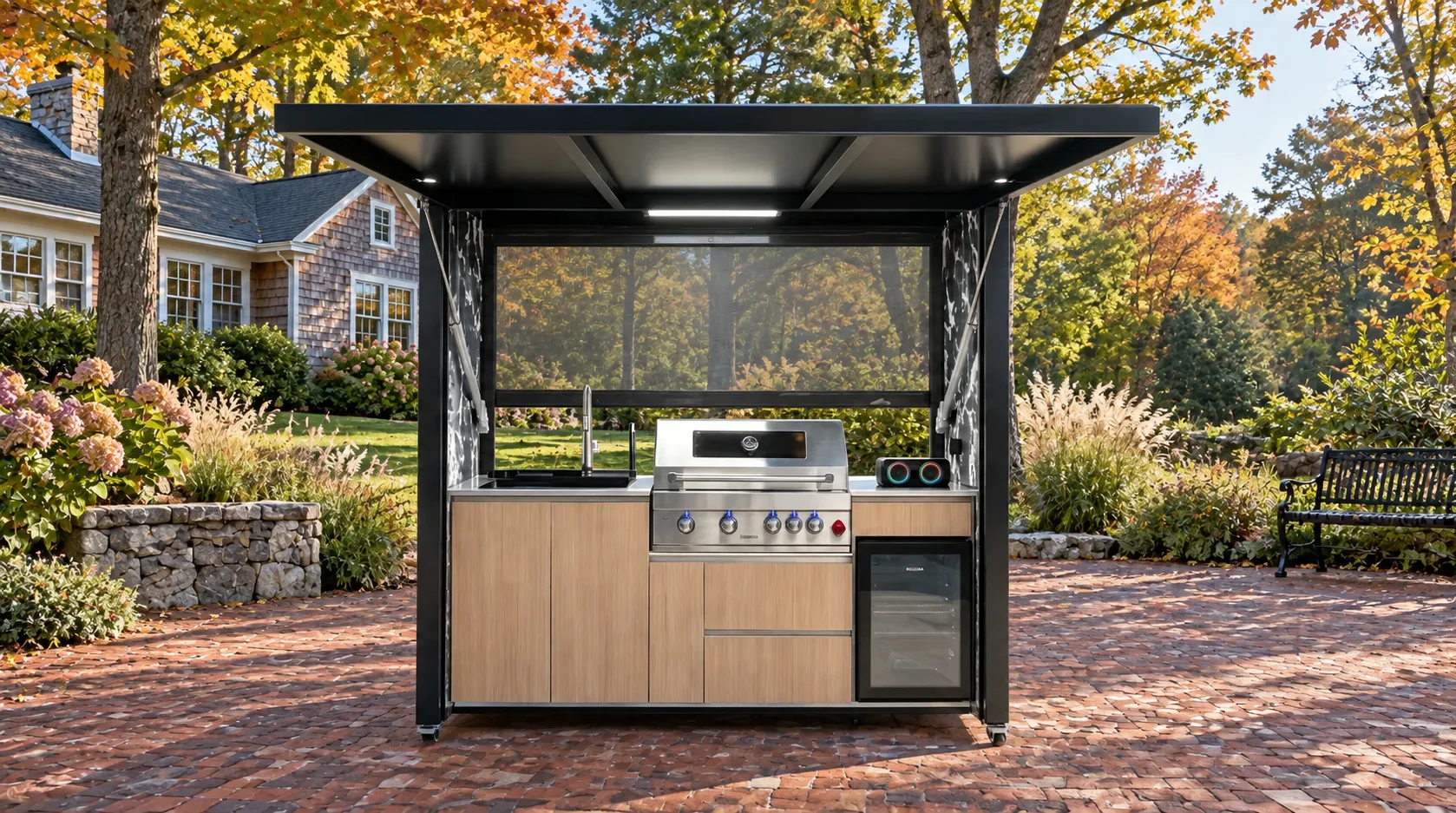
Review the META LIFESTYLE outdoor kitchen with a lift-up door and triple-fuel grill as one product option, then request the current model details before deciding whether it fits your site. Product photos do not establish compatibility with an existing grill island.
For gas, electricity, plumbing, fire clearances, structure, anchoring, drainage, or permits, model-specific documentation and qualified local professionals or authorities control. Do not transfer dimensions or clearances from a different grill, assume an existing connection is suitable, or infer local approval from a prior installation.
Frequently Asked Questions
Can I keep the old island and only replace the grill?
Possibly, but only if the selected grill’s installation requirements, opening, clearances, structure, and service access are compatible with the existing island. Verify the exact appliance guide and ask qualified professionals to inspect the site and connections before committing.
Will a prefabricated kitchen fit where my built-in grill is now?
Not necessarily. A complete kitchen has its own footprint and site requirements, which may differ from a single grill opening. Measure the full patio area and compare it with the selected product’s current drawings before ordering.
Should I choose a new grill before asking a contractor to remove the old one?
It is usually useful to identify the intended replacement and obtain its requirements before removal work is planned. That allows the contractor and relevant trades to compare the new arrangement with the existing structure and services. The right sequence for your home should be set by those professionals.
Can I reuse the existing gas or electrical connection?
Do not assume so. A qualified local professional should inspect the existing connection and compare it with the selected product’s requirements. Any changes must follow model-specific documentation and local rules.
What if I do not know the old grill model?
Share clear photos, measurements, and any labels or paperwork you can find, but mark missing information as unknown. A professional can assess the existing installation; do not estimate cutout or utility details from a photo alone.
Request a Quote for Your Replacement
When you contact META LIFESTYLE to request a quote, include the old island’s measurements, photos, intended scope, and any unknown utility details. Both numbers below are official META LIFESTYLE WhatsApp contacts: +8619050185756 and +1 (626) 735-5685. Ask for the current model documents so your qualified local professionals can evaluate fit, support, clearances, and connections before work begins.